
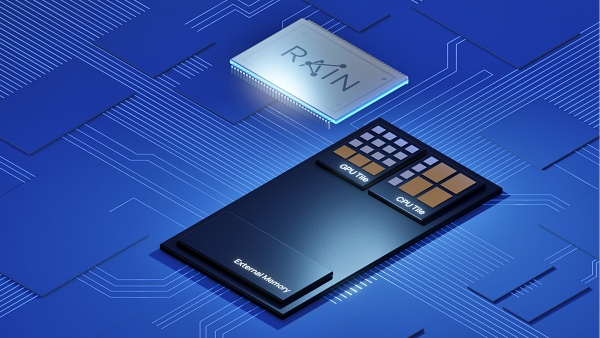
[DigitalToday reporter Jinju Hong] OpenAI is buying key patents from semiconductor startup Rain AI as it continues its in-house AI chip development strategy. It failed to acquire the whole company, but appears to be moving to strengthen hardware competitiveness by securing needed intellectual property (IP).
On Aug. 6, local time, major foreign media outlets including Cryptopolitan reported that OpenAI received some patents after acquisition talks with Rain AI. The deal value and the scale of patents secured were not disclosed. The transaction gives OpenAI a basis to use Rain AI’s neuromorphic semiconductor technology.
Rain AI is a semiconductor startup founded in 2018 that has focused on developing neuromorphic processors that mimic how the human brain processes information. It aimed to improve power efficiency compared with GPU-centred AI computing structures and to lower the cost of training and inference for AI models.
The relationship between OpenAI and Rain AI predates the latest deal. Sam Altman (샘 알트먼), OpenAI’s chief executive, previously invested personal funds in Rain AI. OpenAI also signed a letter of intent in 2019 to buy Rain AI’s AI chips in the future in a deal worth $51 million.
But Rain AI struggled financially after failing to launch a commercial chip. The business contracted because of a lack of funding and failure to secure customers, and it reviewed the possibility of a sale after 2025. It was also reported to have pursued a $150 million Series B fundraising, but that did not materialise.
OpenAI initially sought to acquire Rain AI in full, but the two sides failed to reach agreement on terms. OpenAI later chose to secure patents instead of buying the company. Rain AI is said to have effectively halted operations after most of its workforce left following the breakdown in acquisition talks.
The patent purchase aligns with OpenAI’s push to move faster to secure in-house hardware capabilities. OpenAI is pursuing customised chip development to reduce its reliance on Nvidia GPUs and cut AI service operating costs.
OpenAI is recently working with Broadcom to develop customised AI inference chips and has said the chips could significantly cut AI computing costs. Other AI companies such as Anthropic and Meta are also moving to develop their own semiconductors, as competition in AI infrastructure appears to be expanding from securing GPUs to competing on chip design.
The deal is also drawing attention because it comes as a hardware-related legal dispute with Apple is under way. Apple filed a lawsuit alleging former engineers brought the company’s confidential hardware information to OpenAI, and OpenAI is pushing back by asking a court to dismiss the case.
Apple said about 400 former Apple engineers now work at OpenAI. OpenAI, however, said Apple did not properly block access to work data for departing employees and argued there was no problem with its hiring process. The court has not yet issued a final ruling.
Some in the market see OpenAI’s securing of Rain AI patents as part of a long-term strategy to internalise hardware, beyond a simple technology purchase. It has not been disclosed which AI chips or devices OpenAI may apply the patents to, but its move to build an ecosystem of in-house semiconductors and AI devices is becoming more pronounced.
As the focus of AI competition expands beyond model performance to data centre costs and semiconductor design, attention is on what role OpenAI’s patent acquisition will play in its future in-house chip strategy.
 Jinju Hong
hongjj@d-today.co.kr
Jinju Hong
hongjj@d-today.co.kr