
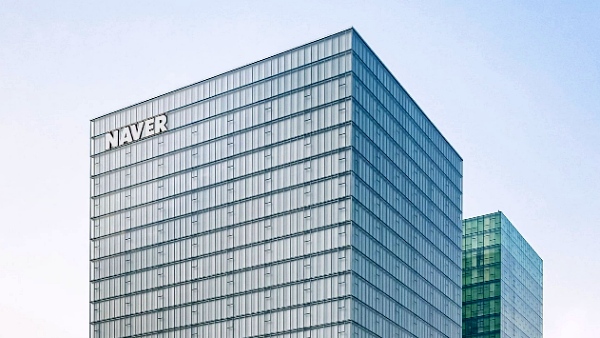
Naver is expanding artificial intelligence infrastructure and consumer services at the same time. With an AI factory being pursued with Nvidia, it is targeting corporate and public-sector computing demand. It is also applying action-oriented AI to search, shopping, Place and payments to convert discovery into purchases and reservations. It also plans to link offline data to merchant solutions and financial revenue through Npay Connect.
Naver unveiled the strategy on a conference call for its 2026 second-quarter earnings release held on Thursday. Consolidated second-quarter revenue rose 16.2 percent from a year earlier to 3.39 trillion won, while operating profit fell 0.2 percent to 520.3 billion won. C2C business and shopping drove revenue growth, but distribution of Npay Connect terminals, World Cup broadcast rights and AI infrastructure-related costs weighed on profitability.
AI factory to expand B2B with 200 MW... expects margin above 20 percent at maturity
Naver said the AI factory, the first pillar of the plan, will start services in the first half of 2027 at 55 MW, expand to 100 MW by the end of that year and reach 200 MW by 2028. It expects revenue to begin in the first half of next year. Chief Executive Choi Soo-yeon (최수연) said, responding to concerns about demand slowing as low-cost, high-efficiency models spread, that as unit compute costs fall, AI adoption, inference and agents will instead expand and drive overall computing demand.
The structure places the AI factory operator as a wholly owned subsidiary of Naver, while a separate special purpose vehicle will secure computing assets such as GPUs and data centres. Nvidia is participating in a third-party allotment paid-in capital increase worth about $1 billion. Brookfield, as preferred bidder, is in talks on a plan to invest up to $9 billion in the SPV. Choi said it has built a foundation to expand the business quickly while minimising the initial capital burden.
The operator will secure revenue and margins through a full-stack service combining GPU computing, cloud and model operations. Naver said initial margins will be low but it expects more than 20 percent once the business matures. On concerns about falling chip prices, Chief Financial Officer Kim Hee-cheol (김희철) said if chip prices halve, the structure means infrastructure purchasable for the same amount doubles. He said the impact is limited because it is not a structure that contracts $9 billion at current prices all at once.
Naver said it will operate the AI factory as a new B2B business and commerce as a core B2C business with independent organisations and resources. It will also pursue the AI factory through an asset-light approach using external capital to minimise any impact on investment priorities for its existing businesses.
AI tab to purchases and reservations... AI ad monetisation begins
The AI tab, a key part of its action-oriented AI strategy, has surpassed 10 million monthly active users as of early August since its launch on June 25. Weekly revisit rates are more than double the early test phase, and click-through rates for shopping and local content are above 40 percent. In the third quarter it will add an agent specialised for finding property listings and for the Whale browser, and it will also introduce a health agent within the year.
AI briefing ads launched in late July are being applied mainly to informational search queries where monetisation had been limited, in order to reduce cannibalisation of existing search-ad revenue. Cost per click and click-through rates are each more than 30 percent higher than existing search ads, and purchase conversion rates improved by more than three times. Second-quarter advertising revenue rose 7.5 percent from a year earlier to 1.45 trillion won, and AI contributed more than 60 percent of the increase. Service revenue rose 31.3 percent to 455.0 billion won, supported by Smartstore growth.
In commerce, Naver is linking its store app, membership and N Delivery into a single structure. Smartstore transaction value rose 15.5 percent in the second quarter, while store app transaction value increased by more than 35 percent and N Delivery transaction value climbed 76 percent. Naver plans to expand direct delivery contracts with sellers to raise the share of direct-contract pickup volume to more than half by year-end. It also plans to introduce a membership-only returns centre and dawn delivery in October.
Offline data via Npay Connect... linking payments, ads and finance
Naver will expand Npay Connect into an AI platform for offline merchants. It brought forward the schedule for terminal distribution on the view that data in the offline commerce market, which it said is more than three times larger than online, is not sufficiently structured. It plans to combine Place search and reservation data with Naver ID, payments and membership data, as well as in-store visit and order data, to advance personalisation and ad targeting for the AI tab and agents.
Monetisation will expand in stages after the merchant base grows, through paid solutions such as CRM and trade-area analysis, financial intermediation and offline advertising. Naver set a goal of becoming South Korea's top operator next year by combined online and offline B2C payment volume, and of increasing offline payment volume to 130 trillion won within 5 years.
As a result of the upfront investment, Naver's second-quarter platform division margin fell 4.2 percentage points from a year earlier, and the financial platform division fell 4.9 percentage points. Kim said operating margin in the second half could temporarily be lower than in the first half as it aggressively expands distribution of Npay Connect terminals.
It also said it views this year as the period when major growth investment is most concentrated and expects the rate of cost growth to slow from next year. It said the key will be how quickly revenue from AI ads, commerce and offline merchant solutions offsets the rise in investment costs.
 Lee Ho-jung
lhj@d-today.co.kr
Lee Ho-jung
lhj@d-today.co.kr