
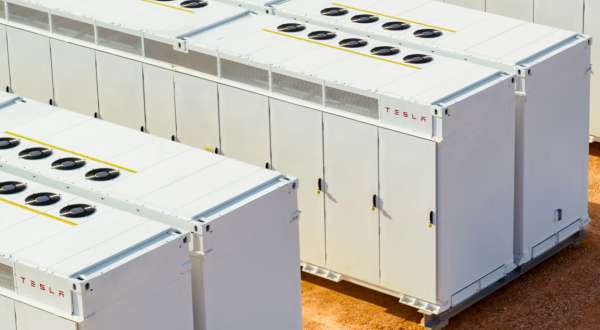
[Digital Today reporter Jinju Hong] Tesla has begun full-scale production of its next-generation grid energy storage system (ESS), Megapack 3. It aims to strengthen competitiveness in the fast-growing global ESS market with a new product that raises energy density and simplifies installation.
Electrek, an electric vehicle media outlet, reported on Wednesday that the first Megapack 3 units are being produced at a newly built Megafactory in Brookshire, Texas.
The Brookshire plant began production about 16 months after construction started and was designed as a dedicated Megapack 3 facility. Tesla said the plant was designed to have annual production capacity of 50 GWh. The large-scale ESS platform Megablock, unveiled with Megapack 3 in September last year, is also expected to be produced at the facility.
The biggest change in Megapack 3 is an increase in storage capacity. Storage capacity per unit is about 5 MWh, up about 28 percent from 3.9 MWh for the previous Megapack 2 XL. It is designed to store more power while keeping the same installation footprint.
Tesla explained it applied a larger 2.8-liter cell format to raise internal energy density without significantly increasing cabinet size. In large-scale grid batteries, efficient land use is directly linked to project viability, so the ability to store more power in the same space is expected to be a competitive advantage.
The thermal management system was also improved. Megapack 3 cut the number of thermal management connection points by about 78 percent compared with the previous generation. In liquid-cooled batteries, fewer connection points reduce the risk of leaks and failures and simplify manufacturing and maintenance work.
For grid ESS, stable long-term operation and quick installation are important, so Tesla focused not only on hardware performance but also on improving the build process itself.
To that end, Megablock, unveiled at the same time, bundles up to 4 Megapack 3 units into one system and pre-integrates transformers and switchgear at the factory. This reduces medium-voltage wiring work that previously had to be done on site, shortening installation time.
Tesla said using Megablock enables energy storage of up to 248 MWh per acre and allows construction of a 1 GWh ESS facility within 20 business days. It also said installation speed can be increased by about 23 percent compared with the existing method.
Tesla's ESS business is growing rapidly. Megapack started in 2019 with a product of about 3 MWh, expanded to 3.9 MWh with Megapack 2 XL in 2022, and Megapack 3 delivered the biggest capacity increase in the generation change.
Building the Brookshire plant is also a step to respond to intensifying global competition. Tesla has produced ESS at its Lathrop Megafactory in California and its Shanghai plant in China, but it plans to expand supply capacity by securing an additional production base. With competition intensifying with global ESS companies such as CATL, Fluence and BYD, the Brookshire plant could grow into Tesla's largest energy storage production base. If it secures annual capacity of 50 GWh as planned, it is expected to play an important role in meeting demand for large-scale ESS.
Market demand is also expanding. Tesla recently signed a $5 billion, 25 GWh contract to supply Megapacks to European energy company NatPower. As electricity demand surges with the spread of artificial intelligence data centers, competition to secure ESS is also increasing.
Still, supply-chain issues remain a variable in the production ramp-up. Megapack 3 requires a stable supply of large LFP battery cells, and Tesla has previously said the profitability of its energy business declined due to the impact of U.S. tariffs on imported LFP cells.
Ultimately, the success of the Brookshire plant depends not only on securing production capacity but also on sourcing battery cells and managing costs. Attention is focused on whether Tesla can use Megapack 3 to expand beyond an electric vehicle company into a global energy infrastructure company.
 Jinju Hong
hongjj@d-today.co.kr
Jinju Hong
hongjj@d-today.co.kr