
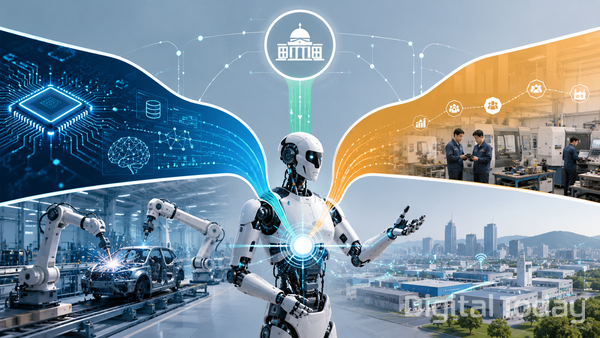
[Digital Today reporter Seulgi Son] The roles of government ministries in fostering physical AI are becoming more concrete. The Ministry of Science and ICT is placing emphasis on securing core AI technologies. The Ministry of Trade, Industry and Energy is focusing on building a base for robot and manufacturing sites and putting institutions in place. The Ministry of SMEs and Startups is stressing the spread of technology to small manufacturers.
As physical AI spans multiple industries and technologies, from AI models, data and computing to hardware such as robots and autonomous driving and application in manufacturing sites, the key is to build on each ministry’s strengths while strengthening links among projects.
At a forum titled “A leap to a global robot foundry for South Korea and the realization of a K-physical AI powerhouse,” hosted by Democratic Party lawmaker Kim Eui-kyeom (김의겸) at the National Assembly Members’ Office Building in Yeouido on Wednesday, Lee Dong-cheol (이동철), director of the Artificial Intelligence Machinery and Robot Division at the Ministry of Trade, Industry and Energy, Lee Ju-sik (이주식), director of the ICT Industry Policy Division at the Ministry of Science and ICT, and Kim Min-su (김민수), director of the Manufacturing Innovation Division at the Ministry of SMEs and Startups, attended and explained each ministry’s policy direction and role for physical AI.
The Ministry of Science and ICT is placing emphasis on securing fundamental and core AI technologies that make up physical AI. It aims to secure domestically technologies that serve as the “brain” of physical AI, including AI semiconductors, simulation platforms, world models and robot foundation models.
Lee Ju-sik said the core physical AI technology stack includes computing and AI semiconductors, with a simulation platform, AI foundation models and devices such as robots, autonomous driving and drones on top. He said Nvidia currently leads this market.
He said the ministry is supporting R&D for key internalization technologies, including world models that produce synthetic data, AI semiconductors that serve as the basis for computing infrastructure and general-purpose AI robot foundation models. He said the government expects synergy once these core technologies are in place as the trade ministry spreads them in the field and the SMEs ministry spreads them to small manufacturers.
The science ministry is also pushing a large-scale R&D project to secure next-generation physical AI technologies. It plans to pursue a 1.4 trillion won physical AI R&D project over the next 5 years centered on North Jeolla and South Gyeongsang provinces, and to support development of software platforms and operating systems that can be used in manufacturing sites.
Lee also mentioned the need to establish laws and institutions tailored to physical AI. He said robots themselves can be addressed under the Intelligent Robots Act, but physical AI includes comprehensive elements such as AI models and data, security and communications. He said a special law on physical AI should be drawn up under the leadership of the science ministry.
He added that through the Physical AI Alliance launched in June, the ministry will build a technology supply platform with about 250 domestic companies and share results with related ministries, including the trade ministry, to link them to industrial diffusion.
The trade ministry is focusing on manufacturing and industrial sites, including creating actual demand for robots, parts, data and institutional improvements.
Lee Dong-cheol said early demand creation is very important. He said the government is running a program to provide subsidies when the private sector buys robots, and is expanding it further into projects in which the government directly purchases defense or research robots.
He said the ministry is expanding R&D for parts, centered on actuators, and is also seeking to build about 10 data factories nationwide.
The government will also overhaul the legal framework for the robot industry. Lee said there has been no major change for about 20 years since the Intelligent Robots Act was enacted in 2008. He said the ministry is pursuing a full revision and aims to submit it to this regular session of the National Assembly after research.
The SMEs ministry is putting its emphasis on spreading physical AI technologies developed and demonstrated by the science and trade ministries to small manufacturing sites.
Kim Min-su said the ministry’s framework related to physical AI largely consists of two pillars: smart factories and a robot automation deployment program. He said the smart factory program supports about 1,500 companies a year and robot automation supports about 200 companies.
The ministry plans to use existing manufacturing innovation programs, including smart factories and robot automation, as a foundation for spreading physical AI. It is pushing a plan to incorporate physical AI technologies into programs such as win-win smart factories in which large companies, the government and partner SMEs participate together.
Kim said the SMEs ministry will be responsible for spreading technologies such as robot foundation models to small manufacturers once they are developed by the science and trade ministries. He added that it plans to expand projects related to physical AI, humanoid robots and robot foundation models next year.
◆ “Physical AI needs linkage beyond ministerial silos”
At the event, experts called for the government to connect each project into a single physical AI ecosystem, along with clarifying roles by ministry.
Lim Tae-beom (임태범), head of the Intelligent Convergence Research Center at the Korea Electronics Technology Institute, said the government’s physical AI strategy presents directions such as data, technology, diffusion and ecosystems, but warned that fragmented projects should not merely achieve individual KPIs.
Lim said it is important for each strategy and project to be organically linked and to achieve common goals in the short term to establish a physical AI ecosystem and secure sustainability. He said measures are needed to enable ministries to cooperate in an active implementation stage.
He also proposed that there is a need to continuously support the physical AI strategy at the national level and to establish a dedicated support organization that can provide the latest technical information to laws, institutions and administration.
There were also remarks that regulation and demonstration systems should not be fragmented by ministry given the characteristics of physical AI.
Ahn Seo-yeon (안서연), a lawyer at Law Firm Lin, said regulatory sandboxes are currently divided among several bodies including the trade ministry and the science ministry, but physical AI combines a range of areas at once, including communications and AI as well as hardware. She said a demonstration system related to physical AI needs to be handled in an integrated way by a single body such as the Office for Government Policy Coordination.
 Seulgi Son
sageson@d-today.co.kr
Seulgi Son
sageson@d-today.co.kr