
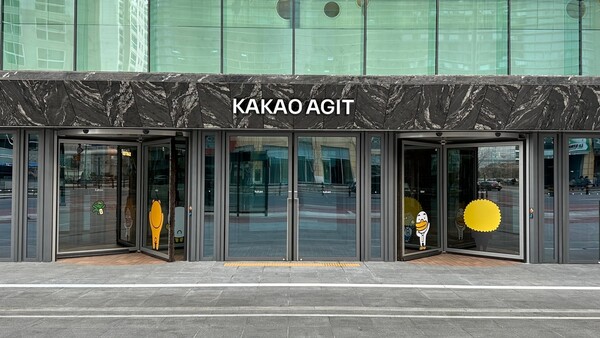
Kakao will focus its capabilities on agent services that identify user intent in KakaoTalk and connect it through to ordering, reservations and payments, rather than directly entering the artificial intelligence (AI) infrastructure business. It plans to start with food delivery and widen the scope to commerce, reservations and travel, aiming to make AI a new growth engine for its TalkBiz business.
Chief Executive Chung Shin-a (정신아) unveiled the AI business strategy on a second-quarter earnings conference call on Wednesday. "AI will be key to reigniting TalkBiz growth and will become a major source of revenue," Chung said.
Kakao plans to expand monthly active users who encounter AI services inside KakaoTalk to about 10 million by the end of this year. It plans to start monetisation next year, focusing on transaction fees and subscriptions. By 2028, when a new form of AI advertising revenue also ramps up in earnest, it aims to raise the share of AI-related revenue in TalkBiz revenue to double digits.
Kakao reported second-quarter consolidated revenue of 2.10 trillion won, up 9 percent from a year earlier, and operating profit of 277.0 billion won, up 36 percent, both quarterly record highs. It said a 17 percent rise in platform revenue provided a financial base to continue investing in AI.
◆ Starting with delivery with Coupang Eats… turning intent in conversations into real transactions
Kakao expects the user experience to shift in the AI era from the existing mobile approach of searching for menus and buttons on screens to making text and voice requests, with agents calling up needed services and providing results. Kakao chose food delivery as the first area for external integration to support that change.
It is preparing a service that links Coupang Eats with the KakaoTalk agent to identify order intent during conversations, recommend menus based on user preferences, and handle ordering and payment inside chat rooms. Kakao sees it as a suitable area to verify the usefulness of agent AI because usage is frequent and fast ordering and payment matter more than comparing information.
Criticism has also emerged that the launch has been delayed compared with the original plan. Kakao said it aimed to build a structure that completes the flow from authentication to ordering and payment, rather than simply linking APIs. It said that required re-designing the service structure and user experience with partners, and coordinating roles and responsibilities, business models and operating standards for both sides during transactions.
Kakao plans to first check whether the integration leads to conversions to ordering and payment and increases partners' transaction volume. It will then provide repeatedly needed functions such as authentication, delegated authority, and ordering and payment through software development kits (SDKs) and an agent builder to reduce development costs and resource burdens for follow-on partners, and expand in stages to commerce, reservations, travel and payments. It will also use the open platform PlayMCP, where more than 3,400 MCP tools are operating and are called more than 100,000 times a day, to expand the ecosystem.
◆ Securing AI usage habits first… monetising transaction and subscription revenue from next year
Kakao is prioritising building habits of repeatedly using AI inside KakaoTalk ahead of monetisation. Kanana in KakaoTalk is improving the service on average every 2 weeks, and the share of positive evaluations for the "first message" feature and AI answers has each exceeded 80 percent and 90 percent, respectively. User retention has also improved, rising from about 70 percent in the first quarter to nearly 80 percent now.
"ChatGPT for Kakao" has secured about 13 million cumulative subscribers, and the average number of outbound messages per person per day exceeded 6. Kakao expanded touchpoints by adding a feature that lets users call up ChatGPT in chat rooms and share its answers, and by adding PC support. In the second half, it plans to ramp up the agent AI experience in Kanana in KakaoTalk, while advancing image generation and chatbot functions for ChatGPT for Kakao.
Based on the user base built this way, monetisation will begin in earnest from next year, focusing on transaction fees and subscriptions. Over the mid to long term, Kakao plans to add AI advertising that uses user intent identified in conversations, expanding its display-advertising-centred business structure into the search advertising area.
Chief Financial Officer Shin Jong-hwan (신종환) said growth in its existing advertising and commerce businesses is beginning to offset the burden of AI investment. He said that growth is making the investment burden manageable until AI contributes to revenue. Second-quarter TalkBiz advertising and subscription revenue rose 14 percent to 399.9 billion won from a year earlier. Display advertising revenue excluding Bizboard tripled from a year earlier and accounted for 45 percent of total display advertising revenue.
◆ Drawing a line on data centres and GPU business… focusing capital on B2C services
Kakao made clear it will not move in earnest into infrastructure businesses such as AI data centres and GPU cloud. Chung said Kakao had sufficiently reviewed the business feasibility across the AI value chain, but concluded it was not the area where Kakao could build the highest competitiveness. She said Kakao's formula for success has been its B2C capabilities in creating services that permeate users' daily lives, and focusing on that capability in the AI era offers higher growth potential.
Financial burden was also a basis for the decision. Chung said hardware equipment such as GPUs and AI servers is replaced very quickly, and competitive supply expansion is also under way. She said it is difficult to guarantee that the high profitability arising from the current demand-supply imbalance will last for a long time. Chung said the expected return on investment (ROI) is not high enough relative to the financial burden that would have to be borne over the long term. She said Kakao will focus on the model and service layer that creates AI services used habitually in daily life by the entire nation, rather than infrastructure where the scale of capital spending itself becomes the essence of competitiveness.
Kakao said the results of this strategy of selection and focus were also confirmed in its second-quarter results. TalkBiz revenue growth returned to double digits for the first time in 4 years, and Kakao's separate operating margin reached 18 percent, the highest since the incorporation of KakaoBrain.
Shin said the company could "exceed without difficulty" its annual targets presented at the start of the year of revenue growth of more than 10 percent and an operating margin of 10 percent. Over the mid to long term, he forecast Kakao's separate operating margin would far exceed 20 percent as AI revenue contribution is added to growth in existing advertising and commerce businesses.
The key ahead is whether the first delivery integration leads to actual conversions to ordering and payment and increases partners' transaction volume, and whether it can be repeatedly expanded into follow-on areas such as commerce, reservations and travel. Kakao expects this process to determine whether AI usage habits and monetisation can take hold inside KakaoTalk.
 Lee Ho-jung
lhj@d-today.co.kr
Lee Ho-jung
lhj@d-today.co.kr