
Sentiment in the Kosdaq, which had been suffering repeated sharp falls, is changing. After the index slipped to the low 700s, it rose for four straight sessions. From July 31 to Aug. 4, a buy sidecar was triggered for three consecutive sessions for the first time ever.
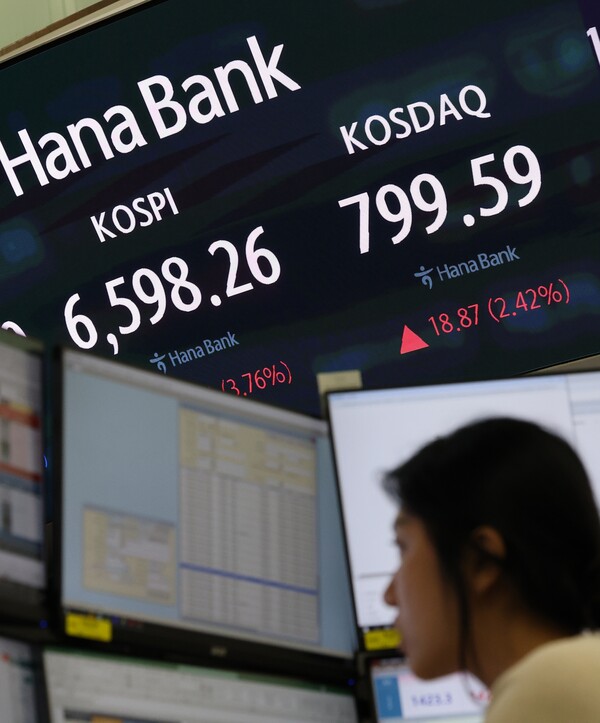
On Aug. 5, the Kosdaq closed up 18.87 points, or 2.42 percent, at 799.59. The index surged 74.98 points, or 11.63 percent, to 719.76 on July 31. It then rose to 737.35 on Aug. 3, up 2.44 percent, to 780.72 on Aug. 4, up 5.88 percent, and to 799.59 on the day, up 2.42 percent, extending gains to four straight sessions.
A buy sidecar, which temporarily halts the effectiveness of program buy orders, was triggered on the Kosdaq on July 31 and on Aug. 3 and 4, for three consecutive sessions. It was the first time ever that a buy sidecar was triggered for three straight sessions on the Kosdaq.
The recent moves contrast with the Kosdaq's sharp decline that lasted until just a few days ago. According to the Korea Exchange, from April 27 to Aug. 4, the KOSPI fell 3.9 percent while the Kosdaq dropped 36.3 percent. Based on the trough at the end of last month, the Kosdaq's decline widened to as much as 47.4 percent.
The Kosdaq's weakness was influenced by an earnings gap with large KOSPI stocks. Earnings forecasts for large caps, led by semiconductors, rose quickly, but the upswing did not spread to small and mid-cap shares.
Benefits from a weaker won and from the U.S. rebuilding its supply chains were also concentrated in large exporting stocks. High market interest rates increased valuation burdens for small and mid-cap shares, whose growth expectations had already been priced into stocks.
A key factor behind the recent rebound is the unwinding of margin loans during the selloff. Outstanding Kosdaq margin loans stood at 5.83 trillion won on Aug. 3, down 47.2 percent from a peak of 11.05 trillion won on April 29.
As falling share prices led to insufficient collateral and forced selling, and that forced selling pushed prices down again, leveraged positions that had amplified the decline were largely cleared. A fall in margin loans does not create new buying demand, but it can reduce the risk of additional forced selling.
A shift to net buying by institutions is also supporting the rebound. From July 31 to Aug. 4, institutions net bought 1.01 trillion won worth of shares on the Kosdaq. Financial investment firms net bought 414.2 billion won, while investment trusts and pension funds also net bought 404.0 billion won.
But much of the buying by financial investment firms included mechanical demand tied to creating leveraged exchange-traded funds, or ETFs, and hedging derivatives. Over the same period, their net purchases of 414.2 billion won were similar to the estimated net creation of leveraged ETFs, excluding index effects, of 414.9 billion won.
By contrast, buying by investment trusts and pension funds suggests discretionary bargain hunting may have begun in oversold territory. An analysis says financial investment firms boosted the speed of the initial rebound, but the durability of the rebound will depend on whether investment trusts and pension funds continue buying.
As interest in the Kosdaq market has increased, asset managers have rolled out a string of Kosdaq active ETFs this year. These products move away from simply tracking existing indices and instead seek returns above a benchmark by letting managers adjust stock selection and portfolio weights.
KoAct Kosdaq Active was listed on March 10, followed by PLUS Kosdaq 150 Active on March 17. MIDAS Kosdaq Active came to market on May 19 and TIGER Kosdaq Active on June 2. DS Kosdaq Active was also listed on July 14, bringing the number of major Kosdaq-related active ETFs listed this year to 8.
These products performed poorly during the sharp selloff. Last month, KODEX Kosdaq 150 and TIGER Kosdaq 150, which track the Kosdaq 150 index, fell 27.22 percent and 27.50 percent, respectively. KoAct Kosdaq Active fell 29.76 percent, TIGER Kosdaq Active dropped 33.87 percent and TIME Kosdaq Active slid 36.08 percent.
In the recent Kosdaq rebound, by contrast, the heavier weighting of growth stocks in active ETFs is leading to a recovery in returns.
According to ETF Check, KoAct Kosdaq Active rose 3.39 percent to 8,540 won on the day, while TIME Kosdaq Active gained 3.48 percent to 7,135 won. DS Kosdaq Active and TIGER Kosdaq Active also rose 4.54 percent and 4.14 percent, respectively.
Through Aug. 4, the Kosdaq rose 21.08 percent over the past three sessions, and all 6 Kosdaq active ETFs listed this year posted excess returns versus their benchmarks.
Short-term returns also rebounded for active and covered-call products tied to the Kosdaq 150. KIWOOM Kosdaq 150 Covered Call Active returned 16.30 percent over the past week, while PLUS Kosdaq 150 Active gained 24.46 percent and RISE Kosdaq Covered Call Active returned 23.11 percent.
Still, some analyses say it is too early to conclude the recent rise alone means the Kosdaq has shifted into a structurally strong phase. That is because the rebound appears largely driven by changed price-formation conditions, such as margin unwinding and institutional flows, rather than broad improvements in corporate earnings outlooks.
According to Shinhan Investment Corp, since 2000 there have been 6 instances in which outstanding margin loans fell more than 30 percent from a one-year peak and the index dropped more than 15 percent from a 60-day high.
Dong-gil Noh (노동길), a researcher at Shinhan Investment, said, "The current Kosdaq rebound is closer to a reversal in price-formation conditions than a reversal in fundamentals." He added, "Remaining forced-selling volumes have declined and discretionary buyers have emerged, so I judge the credibility of a tactical rebound is higher than in the previous two cases."
"Still, to expect the Kosdaq's structural relative outperformance, demand from investment trusts and pension funds must continue even after mechanical buying by financial investment firms weakens, and earnings upgrades must spread to small and mid-cap stocks," he said.
 Sang-yeop Oh
yub@d-today.co.kr
Sang-yeop Oh
yub@d-today.co.kr