
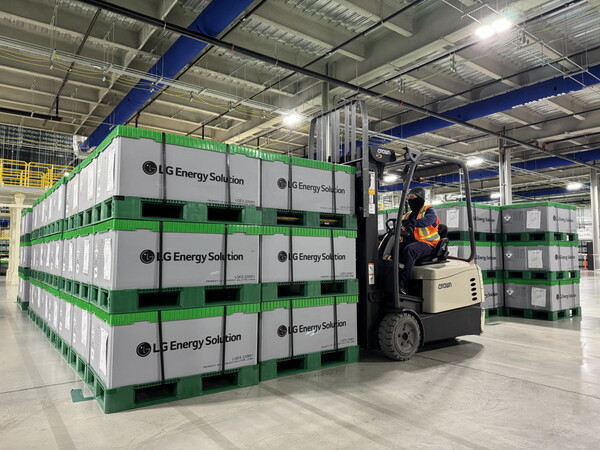
LG Energy Solution, Samsung SDI and SK On, three Korean battery makers, returned to profit in the second quarter. Even so, assessments say their core businesses remain weak once Advanced Manufacturing Production Credit (AMPC) subsidies, one-off gains and the effects of business restructuring are stripped out. All three companies said they brought forward the timing of their return to profit, but the main axis of improvement is shifting from electric vehicles to energy storage systems (ESS) and data centre demand.
According to their recently released second-quarter results, LG Energy Solution posted operating profit of 113.3 billion won, returning to profit after two quarters. North American production subsidies reflected in the results came to 241.0 billion won, exceeding the operating profit itself. Its cumulative net loss for the first half totalled 1.27 trillion won. Samsung SDI returned to the black after seven quarters with operating profit of 203.8 billion won, helped by AMPC benefits tied to U.S. local production and the impact of tariff refunds.
SK On posted operating profit of 821.8 billion won, the biggest among the three battery makers, returning to profit after seven quarters and delivering its best result in 19 quarters since it was spun off in 2021. A major driver was Ford's withdrawal from their joint venture in May, which left SK On operating the Tennessee production base on its own. Leaving the joint-venture structure maximised its AMPC subsidy benefits, leading to the surge in operating profit. It is clear all three escaped large losses or weak performance in the second quarter of last year, but much of the profit rests on policy subsidies, one-off items and governance restructuring.
The numerical rebound is clear. Yet the share of external factors such as subsidies, compensation and refunds is larger than that of a structural demand recovery, prompting an assessment that this profit is only a half success. The key question for the visibility of improvement is whether they can post profits even without subsidies. LG Energy Solution and Samsung SDI forecast they would be able to secure profitability from the fourth quarter even excluding AMPC. Both companies, however, expect initial operating costs and ramp-up burdens to continue through the third quarter, meaning a meaningful entry into profit is likely to be confirmed only late in the second half.
◆ The battleground is data centre batteries, not EVs
The common driver of this rebound was ESS, not electric vehicles. LG Energy Solution's ESS shipments rose mainly in North America and Europe, growing more than 30 percent from the previous quarter. First-half revenue increased 4.6 times from a year earlier, helped by a response that shifted EV production capacity to ESS. Its share of companywide revenue also expanded to the high 20 percent range.
Samsung SDI posted operating profit of 159.3 billion won in its battery segment, supported by UPS (uninterruptible power supply) and BBU (battery backup unit) products, high-output batteries for power tools and European EV sales. Battery-segment revenue rose 18.8 percent from a year earlier. SK On also moved to secure new revenue sources as the slowdown in EV demand lengthened, formally launching its Grid On ESS-only brand and converting part of its existing EV lines for ESS. As the EV market continued to slow, mainly in North America, ESS filled the gap in results.
Behind ESS becoming the main player in secondary batteries is AI data centres. Data centres previously connected to the power grid, but as they increasingly build their own power infrastructure, demand is rising for behind-the-meter (BTM) power consumption areas, standalone ESS, and UPS and BBU. Delays in grid connections and growing variability in data centre load are supporting this trend.
LG Energy Solution said new orders in the first half totalled 3.0 trillion won and included data centre projects whose end customers are hyperscalers. Samsung SDI, citing its competitiveness in prismatic batteries in the United States and its local production capabilities, signed long-term supply contracts with major ESS customers. It is preparing mass production of prismatic LFP batteries and an expansion of UPS production capacity.
◆ Risk of 'optical illusion' rather than 'recovery' if cost gap with China persists
All three see a gradual recovery in EV demand and are shifting their focus to data centres and robots. LG Energy Solution plans to respond to BBU and robot markets with high-output tabless 2170 batteries, and to start operating its U.S. Arizona 46-series line in the fourth quarter after improving equipment efficiency by 50 percent compared with before. Samsung SDI is expanding cooperation with major customers in the humanoid and aerospace sectors, where high growth is expected, and is developing sodium-ion batteries for UPS and ESS while detailing mass-production plans. SK On is pursuing certification of a liquid-cooling solution for data centres with global server companies, while also accelerating efforts to develop defence and unmanned-robot markets. It is in talks on battery supply with Hyundai Rotem, a U.S. AI-based unmanned underwater vehicle company and a European defence company.
The remaining task is a shift to prismatic batteries, which are seen as a key form factor for the next projects, and the ability to raise funds to support it. The industry points out that even if ESS and data centre demand sustain the earnings rebound, the return to profit could end up as an optical illusion rather than a recovery if the cost and investment gap with Chinese rivals is not narrowed. Ultimately, the direction of EV demand in the second half and the pace of recognising volumes for data centres are cited as variables that will determine whether this profit turns into a trend.
 Seok Dae-geon
d2dg@d-today.co.kr
Seok Dae-geon
d2dg@d-today.co.kr