
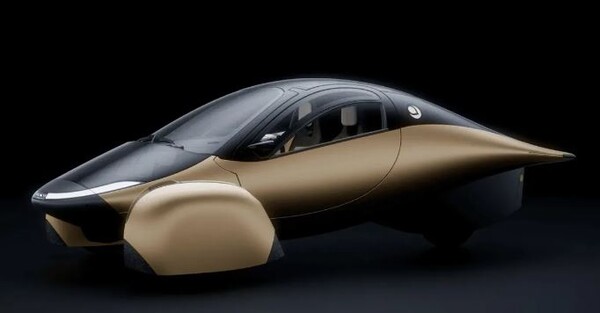
U.S. electric vehicle startup Aptera has begun preparing for an initial mass production run of a three-wheeled EV equipped with solar panels. After securing U.S. Environmental Protection Agency (EPA) certification for its production model, it completed orders for parts needed to build the first vehicles for customer delivery, bringing commercialisation into view.
On Aug. 5 local time, EV outlet CleanTechnica reported that Aptera has completed orders for body and chassis components, targeting production of 40 market-ready vehicles. The parts are due to arrive at its California plant in October.
Aptera has pursued a strategy of adopting a three-wheeled structure instead of a typical four-wheeled EV to reduce vehicle weight and improve energy efficiency. The company described the vehicle as a practical EV designed to reduce charging burden in everyday driving such as commuting, grocery runs and weekend trips, rather than as a simple concept model.
Mass production preparations are also tied to the certification process. Aptera said in July that its production model, the Launch Edition, obtained an EPA certificate of conformity. That means the vehicle meets federal emissions standards under the U.S. Clean Air Act.
For U.S. sales, the final hurdle remains meeting the Federal Motor Vehicle Safety Standards (FMVSS). Aptera said it is conducting related procedures while test-driving validation vehicles on public roads. The company also stressed that the parts it has secured are for the first mass-produced vehicles to be delivered to customers, not for design-validation prototypes.
Aptera's biggest differentiating feature is its solar charging system. The company said the vehicle can travel up to about 40 miles, or about 64 km, per day depending on conditions using only the solar panels installed on it. In tests, it secured about 40 miles of range even on a clear day while parked facing one direction, and on cloudy days it was able to charge about 36 miles by adjusting the vehicle's orientation. Aptera added that parking with the front of the vehicle facing east or west can increase solar power generation efficiency.
The three-wheeled structure is also presented as an advantage in road use. California ended a benefit last September that allowed solo drivers of EVs to use high-occupancy vehicle (HOV) lanes on highways, but autocycles and motorcycles can still use HOV lanes without a passenger under current rules. Aptera said its vehicle is classified as a three-wheeled vehicle, so it can receive the same benefit in areas where the relevant regulations apply.
Aptera is also steadily expanding its production base. It has already secured solar cells capable of producing more than 100 vehicles, and earlier this year it signed a seven-year battery supply contract with LG. The Launch Edition is priced at $40,000 and has a range of about 400 miles, or about 644 km, on a single charge. A 250-mile, or about 402 km, model is priced at $28,000, a 600-mile, or about 965 km, model at $45,000, and a 1,000-mile, or about 1,610 km, model at $55,000.
Aptera pursued development of a solar EV in 2006 but was liquidated in 2011 due to fundraising problems. It was relaunched in 2020 as a three-wheeled EV company and has continued development since then.
The industry sees the initial mass production preparations and progress in federal certification as an important turning point in gauging whether Aptera's long-running commercialisation project can move to the stage of delivering vehicles to customers.
 Jinju Hong (홍진주)
hongjj@d-today.co.kr
Jinju Hong (홍진주)
hongjj@d-today.co.kr