
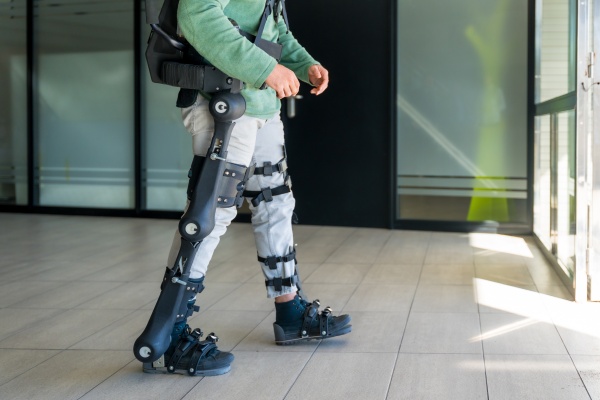
[DigitalToday reporter Jinju Hong (홍진주)] China's wearable exoskeleton robot market is growing rapidly and has reached its largest size on record. As use expands beyond medical rehabilitation to elderly assistance, tourism and leisure, and industrial sites, analysts say China is accelerating in the race to commercialise Physical AI.
Cryptopolitan, a blockchain media outlet, reported on Aug. 4 local time that market research firm IDC said China’s exoskeleton robot shipments in 2025 totalled about 26,000 units and the market was worth more than 1.6 billion yuan. This is the first time IDC has officially tallied the size of China’s exoskeleton robot market.
IDC said 2025 was the year China’s exoskeleton robot industry set a new peak in the commercialisation stage. The market is broadly divided into medical rehabilitation, consumer assistance and industrial use, and growth trajectories differ across the segments.
Medical rehabilitation exoskeleton robots accounted for the largest revenue. The segment was worth about 1.42 billion yuan, making up most of the overall market. Shipments, however, were about 3,200 units. Major buyers include hospital rehabilitation centres, specialist clinics and recovery treatment facilities. IDC analysed that population ageing, rising demand for rehabilitation care, localisation of imported equipment and expansion of basic rehabilitation services combined to make healthcare the most mature market. Fourier Intelligence, Qingtian Technology and Milebot were seen as having secured competitiveness in this segment.
Consumer-assist exoskeleton robots, by contrast, drove market growth in unit sales. Revenue in the segment was about 110 million yuan, but shipments were about 19,000 units, accounting for more than 70 percent of total volume.
IDC cited falling prices and expansion of the silver economy as key growth factors. It said demand is rising among consumers aged 50 and older for walking assistance, hiking and support for tourism activities, rapidly expanding the mass consumer market.
In particular, exoskeleton robot rental services have also emerged at tourist sites in China. At the Great Wall, tourists can wear exoskeleton equipment to reduce the burden of movement while climbing. At Mount Tai in Shandong province, the Taishan Culture and Tourism Group operates 500 units of equipment from Conqing Technology. The equipment weighs about 1.8 kg and can be used for up to 8 hours on a single charge. On-site operators said peak-season utilisation reached 80 percent.
The industrial exoskeleton robot market is still at an early stage. Industrial products used at warehouses, auto plants, power facilities and emergency response sites recorded shipments of about 3,800 units, with market size estimated at 80 million yuan.
Price competitiveness is cited as a key factor behind the expansion of China’s exoskeleton robot market. At the Canton Fair in Guangzhou in April, a Chinese company began taking pre-orders for a rehabilitation exoskeleton robot at $1,200, and the final selling price was expected to be less than 10,000 yuan. A video of an Argentine buyer wearing the device and standing up unaided spread through a Douyin livestream, drawing hundreds of orders.
Manufacturing capabilities and supply chains built in the electric vehicle and battery industries are cited as factors behind Chinese companies’ ability to secure price competitiveness. A report related to the Korea Institute for Robot Industry Advancement analysed that under state support, China’s robot industry has an industrywide foundation combining supply chains, a production base and research and development personnel.
The investment market is also expanding rapidly. IDC said China recorded 19 investment deals in the exoskeleton robot sector in 2025, raising 2.2 billion yuan. That compares with 8 deals and 292 million yuan in 2024, a sharp increase in funding. Overseas expansion is also continuing. Leisure exoskeleton robot company Hypershell has sold more than 30,000 units worldwide and is also pursuing entry into the South Korean market this year.
External variables remain. The U.S. Federal Communications Commission banned imports of Chinese-made humanoid and quadruped robots on national security grounds. Exoskeleton robots were not directly included in the measure, but because they are on the same supply chain, they have not fully escaped political burden. As a result, China’s exoskeleton market faces a situation in which it must assess the impact of trade regulation while continuing to expand domestic demand and pursue overseas growth.
 Jinju Hong
hongjj@d-today.co.kr
Jinju Hong
hongjj@d-today.co.kr