
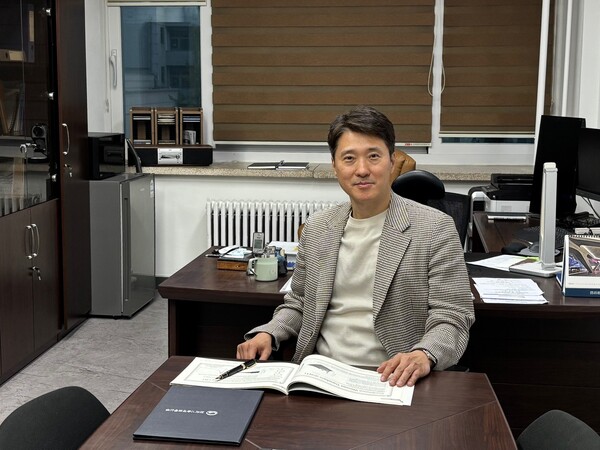
South Korea's Ministry of Science and ICT and the National Research Foundation said on Tuesday they selected Lee Jong-han (이종한), a professor in the Department of Civil and Environmental Engineering at Inha University, as the August winner of the Republic of Korea Science and Technology Award.
Lee was recognised for developing "live digital twin technology" that integrates analysis of material degradation, component damage and structural behaviour in social infrastructure.
Existing facility management systems have been limited to analysing individual causes of damage or conducting inspections after accidents, making it hard to predict complex damage and future performance deterioration.
Lee's research team quantitatively identified nonlinear concrete deterioration processes in environments where freezing and thawing, carbonation and salt damage occur at the same time. Using analysis methods that link various variables, including loads from heavy vehicle traffic, it laid the groundwork for precisely predicting where damage occurs and how it spreads.
The team also built a framework that automatically converts BIM (Building Information Modeling), a 3D information model based on design drawings, into FEM (Finite Element Method) models for analysis. It also reflected analysis results back into a virtual environment, allowing integrated management of past and current conditions and future performance changes across space and time.
Lee developed the technology with support from the ministry's Basic Research Laboratory programme. Related findings were published in 2025 in several international academic journals, including Reliability Engineering and System. He also completed patent applications and software registration.
Lee said the live digital twin technology is meaningful because it shifts maintenance from relying on after-the-fact inspections to a predictive, proactive system. He said he would expand the technology beyond bridges to various infrastructure, including tunnels and ports.
The Republic of Korea Science and Technology Award selects 1 researcher each month who has created original research achievements over the past 3 years and contributed to the advancement of science and technology, awarding a deputy prime minister's prize and 10,000,000 won in prize money. The ministry renamed the award from "Scientist of the Month" to the Republic of Korea Science and Technology Award starting this year.
 Jin-ho Lee
jhlee26@d-today.co.kr
Jin-ho Lee
jhlee26@d-today.co.kr