
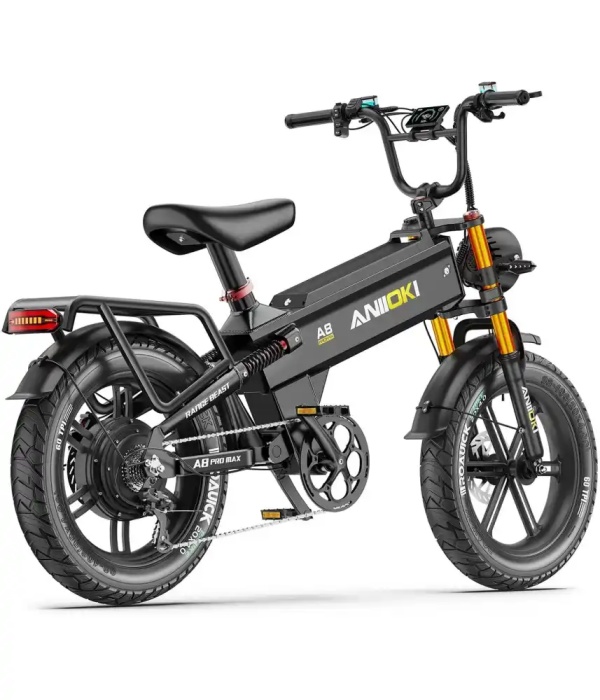
[DigitalToday reporter Jinju Hong (홍진주)] A new era is emerging in which pedal-equipped electric bicycles deliver performance on par with electric motorcycles. Chinese electric mobility company Anioki is drawing attention after unveiling an ultra-high-output e-bike with dual motors rated up to 6,000W and a large-capacity battery close to 5 kWh.
On Aug. 3 (local time), EV outlet Electrek reported that Anioki unveiled its high-performance fat-tire e-bike, the A9 Pro Max Dual Motor 2.0. The product keeps the appearance of an e-bike, but its top speed, power output and battery capacity far exceed typical e-bike standards and were designed to be effectively close to an electric motorcycle.
The A9 Pro Max Dual Motor 2.0 has a typical e-bike form, with 26x4.8-inch fat tires, pedals and a bicycle saddle. But the base 60V 2.0 model uses 2,500W dual motors to deliver up to 6,000W of output. The company lists a top speed of 64 to 70 kph.
The higher 60V 3.0 version supports up to 7,000W of output based on 3,000W dual motors, with a top speed of 82 to 88 kph. The top 72V model combines a 72V battery system with 3,000W dual motors and can travel at 87 to 98 kph, the company said.
Its battery performance is also on a different level from typical e-bikes. The 60V model is equipped with a 70Ah (4,200Wh) or 80Ah (4,800Wh) battery. That is several times the capacity of the 600 to 800Wh batteries used in typical commuter e-bikes. Electrek said that given that many cargo e-bikes struggle to exceed 1,000Wh, the A9 Pro Max battery already falls into the realm of small electric motorcycles.
Anioki claimed it can travel up to 320 km using pedal assist under ideal conditions. Actual range can vary widely depending on speed, road conditions, rider weight and how much the throttle is used.
It also strengthened safety and durability. Anioki said it applied a 4 mm-thick aluminium battery case, semi-solid-state blade battery cells and battery management system (BMS) protection. It also said its in-house, patented frame is twice as strong as a standard bicycle frame and can withstand a load of up to 180 kg.
The braking system is also differentiated from typical e-bikes. The A9 Pro Max uses a combined braking system and large 300 mm brake rotors. The 72V model, in particular, adds an eight-piston front caliper and a six-piston rear caliper to handle high-speed riding conditions. Electrek said this parts setup is commonly used in electric motorcycles rather than standard bicycles, and said, “This product is in a completely different realm from existing e-bikes.”
What is drawing industry attention is a legal classification issue rather than performance. It is being sold as an e-bike because it has pedals, but there is criticism that it is difficult to view a product with speeds above 80 kph and 6,000 to 7,000W output under existing e-bike standards.
In major markets including the United States, e-bikes are generally limited to motor output of about 750W or less and assisted speeds of around 20 to 28 miles per hour. As a result, the A9 Pro Max could be classified as an electric moped or a light electric motorcycle depending on local regulations. Electrek said, “The core issue is not whether this product is an e-bike, but that it is difficult for it to be legally recognised as an e-bike.”
Recently, a niche market between e-bikes and electric motorcycles has been growing rapidly. As more consumers want higher speeds and longer range, demand for high-output mobility is also rising.
But fitting pedals does not make every product an e-bike. The A9 Pro Max Dual Motor 2.0 is expected to become an example that shows both the growth potential of the high-performance electric mobility market and the task of establishing regulatory standards suited to new means of transportation.
 Jinju Hong (홍진주)
hongjj@d-today.co.kr
Jinju Hong (홍진주)
hongjj@d-today.co.kr