
More mid-sized and small companies are using the corporate restructuring scheme as a springboard to newly enter advanced industries. The Ministry of Trade, Industry and Energy’s committee reviewing restructuring plans approved 31 companies in three rounds from December last year to July this year. They plan to invest 439.5 billion won over the next five years and hire 927 new employees. This newspaper calculated the totals by combining the data released for each round. The areas of expansion are concentrated in glass substrates for semiconductor packaging, augmented reality (AR) glass modules and electric vehicle powertrain parts.
Approved cases commonly shift existing process technologies into upstream markets rather than building new facilities. Ut-I, approved on April 14, is moving its high-precision glass manufacturing technology used to make ultra-thin glass into glass substrates for semiconductor packaging. Seoul Semiconductor is entering the display module market for AR glasses using its core microLED technology. GSR Tech, which started in refractory construction for steel blast furnaces, will extract lithium from refractories discarded after cathode material production and supply it as a raw material for cathodes.
The same pattern is repeated in autos and batteries. Geonwoo Metal is adding an artificial intelligence autonomous manufacturing model to its manufacturing technology for bearings and transmission parts for internal combustion vehicles to develop a ring-shaped power gear for EVs. Samsung Precision, approved on July 31, shifted its brake manufacturing technology to drum brakes for EVs. Seonjae Hitech, approved in December last year, expanded its static removal technology for display equipment into manufacturing carbon nanotube dispersions that ease volume expansion in silicon anode materials. It is essentially keeping existing equipment and core technologies while changing the customers.
The remaining constraint is financing. The ministry has provided investment-attraction consulting for approved companies since this year. At the first investment briefing held on Sept. 24 last year at BEXCO in Busan, five companies including IDR System and Elline presented business models to about 30 specialised investment firms. At the second briefing held in Seoul two days later, six companies presented to about 60 investment firms. Lee Seung-ryeol (이승렬), then head of the ministry’s industrial policy office, said, "Since financing is key to successful restructuring, we will expand investment consulting and briefings to further strengthen ties between companies and investors."
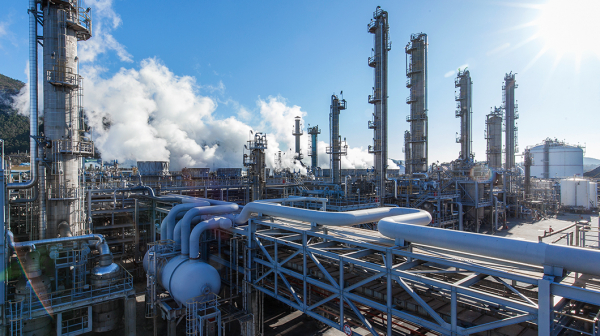
This differs from restructuring’s role when it was used for reduction and cuts. In petrochemicals, restructuring that reduces facilities is under way. The ministry approved the Yeosu Project No. 1 submitted by Yeocheon NCC, Lotte Chemical, Hanwha Solutions and DL Chemical on July 20 and decided to stop ethylene production facilities with annual capacity of 1.39 million tons. The target covers 920,000 tons at Yeocheon NCC’s second plant and 470,000 tons at its third plant, which has already stopped operating. Ethylene production capacity will fall to 900,000 tons from 2.28 million tons.
In the Daesan Project No. 1 approved on Feb. 23, 1.1 million tons of naphtha cracking capacity at Lotte Chemical’s Daesan plant will stop operating. Combined, the two projects would cut around 2.5 million tons, close to the lower end of the annual target of 2.7 million to 3.7 million tons set in a voluntary agreement by the government and industry.
A turnaround after 10 years of an application-driven approach... whether the recommendation system works is a variable
As companies shift toward advanced industries, the nature of the scheme itself is also changing. Amendments to the Corporate Vitality Act passed the National Assembly on March 31 allow the government, after basic and in-depth reviews, to select industries that need restructuring and recommend that companies in those industries examine the need for restructuring. It shifts from a structure where review began only when a company applied to one where the government first identifies industries. The restructuring period for oversupply, supply chain stability and industrial crisis area types was extended to five years. The law also specifies a deferral of credit risk assessments by main creditor banks for approved companies. The amended law takes effect six months after promulgation.
The direction of expanding the scope of application is expected to follow Japan’s path. The Korea Institute for International Economic Policy (KIEP) analysed that Japan’s Industrial Competitiveness Enhancement Act does not limit its purpose to restructuring oversupplied industries, but broadly sets it to include proactive restructuring and support for developing new businesses. It said South Korea’s Corporate Vitality Act also needs to go beyond the scope of oversupply. The act started in 2016 as a temporary law, added a type for entry into new industries in 2019, and created a supply chain stability type in 2024 as it was converted into a permanent law.
A point to watch is whether the new system, under which the government identifies industries and recommends restructuring, will work even in areas that have yet to reach agreement. The remaining areas are Ulsan and Yeosu Project No. 2. SK Geocentric, Daehan Yuhwa and S-Oil are discussing integrating naphtha crackers but are not believed to have reached a specific agreement. Yeosu Project No. 2, which includes LG Chem and GS Caltex, has not set a date for submitting a final plan. Moon Shin-hak (문신학), vice minister of trade, industry and energy, said, "It is more necessary than ever to make the industrial ecosystem more efficient and advanced through proactive restructuring by key supply chain companies."
 Dae-geon Seok
d2dg@d-today.co.kr
Dae-geon Seok
d2dg@d-today.co.kr