
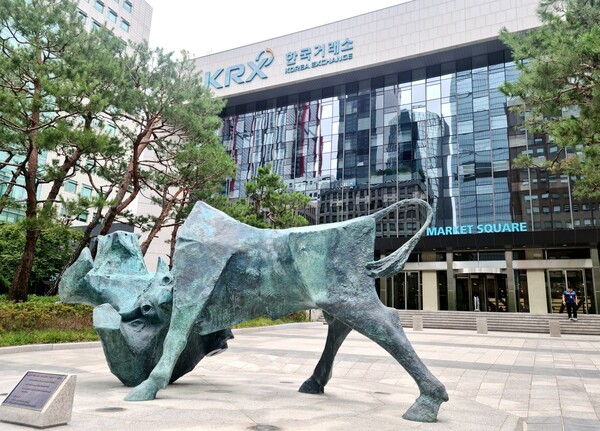
As reforms on duplicate listings unveiled by the Financial Services Commission and the Korea Exchange take effect from the 3rd, the bar has been raised for re-listing an unlisted subsidiary controlled by a listed company. A subsidiary created through a spin-off must obtain approval from the parent company’s shareholders. Acquired or newly established subsidiaries must also undergo enhanced screening if they do not obtain approval, and changes are expected in the IPO market centered on large conglomerate affiliates.
The reform plan, in principle, restricts duplicate listings but allows listings as exceptions when protection measures for the parent’s minority shareholders are in place and the subsidiary’s independence is confirmed.
The scope covers subsidiaries included in a listed company’s consolidated financial statements and unlisted affiliates in a vertical control relationship. It also includes structures in which a listed company holds at least 20 percent of the affiliate’s shares, or the affiliate holds more than 50 percent of its own subsidiaries’ shares.
Companies that were in a controlling or subsidiary relationship within 1 year before the application date for a preliminary listing review are also subject to review. The measure is intended to prevent companies from avoiding regulation by adjusting stakes just before listing. Backdoor listings through special purpose acquisition companies, or through mergers with listed firms, are also included.
Five obligations are imposed on the parent company’s board, including assessing how a subsidiary listing would affect the parent’s share price, ownership structure and dividends, and preparing measures to protect shareholders. The board must communicate with shareholders or confirm whether approval is granted, then vote on whether to support the listing and notify and disclose the result to the subsidiary.
Before the board fulfills the five obligations, it must undergo deliberation by a special committee made up of at least 3 directors or external experts. An independent director must chair the committee, and independent directors and independent external members must account for at least two-thirds of its members.
Proposed shareholder protection measures include cash dividends and treasury share cancellations using proceeds from the subsidiary’s sale of existing shares, in-kind dividends of subsidiary shares and the parent’s investment in new businesses. The parent can also pledge not to pursue additional business spin-offs or the listing of other subsidiaries for a certain period.
A spun-off subsidiary cannot pursue listing if it fails to obtain shareholder approval at the parent. The approval procedure applies by analogy the so-called 3 percent rule used for appointing audit committee members. Shareholders holding voting rights above 3 percent can exercise voting rights only up to 3 percent, and the largest shareholder aggregates stakes held by related parties.
For an approval proposal to pass, it must win a majority of shares represented at the general meeting and at least one-quarter of total outstanding shares with voting rights. Electronic voting is recommended, not mandatory, and even if electronic voting is implemented, the requirement of approval by at least one-quarter of total outstanding shares remains unchanged.
For general subsidiaries that are not spun off, obtaining shareholder approval is presumed to satisfy shareholder protection requirements. Even without approval, a listing is not immediately blocked, but the company must undergo enhanced case-by-case screening based on fundraising needs, industry characteristics and how the parent-subsidiary relationship was formed.
Low-weight subsidiaries, for which sales, operating profit and assets are all less than 10 percent of the parent’s levels, are exempt from the shareholder approval procedure. They are excluded from the exemption if deemed important subsidiaries, such as when expected enterprise value exceeds 10 percent of the parent’s enterprise value. Spun-off subsidiaries must obtain shareholder approval regardless of size.
Even low-weight subsidiaries are not exempt from the parent board’s five obligations, such as impact assessment and preparation of shareholder protection measures, or from screening of the subsidiary’s business and management independence.
Shareholder approval does not guarantee a listing. If 50 percent or more of a subsidiary’s sales or purchases arise from transactions with the parent, it is presumed in principle to lack business independence. Exceptions may apply if vertical integration is unavoidable due to industry characteristics or transaction efficiency is recognized.
Even before the system took effect, some companies changed IPO plans due to the burden of duplicate listings.
SK Enmove tentatively suspended its listing after conducting prior consultations with the exchange in 2025, and SK Innovation acquired 30 percent held by financial investors to bring it in as a wholly owned subsidiary. LS eSix Solutions withdrew its preliminary listing review application on Jan. 26 this year.
Duksan Nupcoarse and DTS, by contrast, passed preliminary listing reviews for the KOSDAQ market on the 20th of last month after going through shareholder protection procedures including parent shareholder approval and impact assessments.
A comprehensive share swap between Naver Financial and Dunamu could also be affected at a future IPO stage. The two companies plan the share swap date for Dec. 31, and if the transaction is completed as planned, Naver Financial will hold 100 percent of Dunamu.
Naver’s stake in Naver Financial will fall to about 17 percent, but it plans to secure about 46.5 percent of voting rights through voting right delegation from major Dunamu shareholders and keep Naver Financial as a consolidated subsidiary.
Naver Financial was established in 2019 when Naver spun off its Naver Pay business unit.
If an IPO is pursued under a structure in which Naver continues to effectively control Naver Financial and keep it as a consolidated subsidiary even after the share swap, Naver’s board would be expected to have to fulfill the five obligations and Naver shareholders would be expected to need separate approval.
A financial investment industry official said, "As duplicate listing guidelines have become clearer, companies pursuing listings have moved away from a war of nerves and secured predictability."
 Oh Sang-yup
yub@d-today.co.kr
Oh Sang-yup
yub@d-today.co.kr