
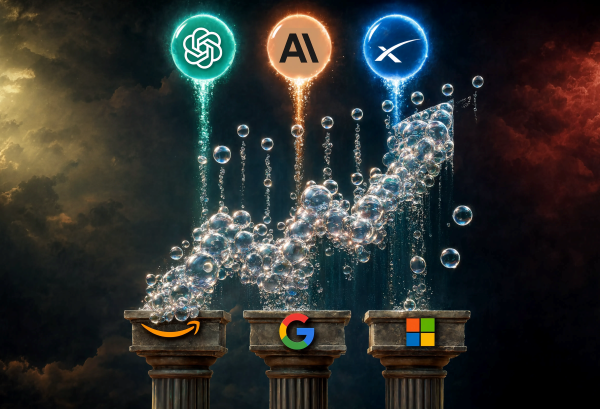
A sharp jump in the value of stakes in unlisted artificial intelligence (AI) companies is making Big Tech’s recent quarterly results look stronger than they are.
CNBC reported on Aug. 3 that Microsoft, Amazon and Alphabet boosted net profit growth by reflecting large investment gains from rising valuations of stakes in Anthropic and OpenAI, and in some cases SpaceX.
The key point is that these gains did not come from core businesses such as software or cloud services. Anthropic and OpenAI surged in value in private markets amid AI investment fervour, and Big Tech holding stakes had to reflect valuation gains in quarterly profit and loss statements. Such figures differ in nature from results generated by operating activities.
The impact has shown up in overall market results beyond individual companies. Tajinder Dhillon (타진더 딜런), head of earnings and equity research at LSEG, said S&P 500 profit growth for the recent quarter was calculated at about 48% from a year earlier, but the increase becomes much more modest excluding investment gains tied to unlisted AI companies. Dhillon said that even excluding only Alphabet and Amazon’s valuation gains on unlisted stakes would lower overall profit growth to about 29%. That is closer to the market forecast of 24%.
Such one-off factors also helped widen the scale of earnings surprises. Companies beat market estimates by an average of 7% this quarter. That is above the long-term average of 4.4%. Many analysts, however, exclude such items from their estimates.
The structure is more sensitive because large technology stocks make up a big share of the market. LSEG said the so-called Magnificent Seven accounted for about 35% of S&P 500 second-quarter revenue. Over the past year or so, these stocks have made up about one-third of the large-cap index. Such investment gains are typically reflected under “other income”, but accounting methods and disclosure levels vary by company.
By company, Amazon had the biggest impact. Amazon is a major investor in OpenAI and pledged in late February to invest $50 billion in the ChatGPT developer. It is also an early investor in Anthropic. Amazon’s net profit rose more than 240% from a year earlier, but the increase was close to 17% excluding investment gains. Amazon said $53.4 billion of profit this quarter came largely from its investment in Anthropic.
Alphabet showed a similar pattern. Google parent Alphabet holds about a 5% stake in Elon Musk’s space company SpaceX and also has a stake in Anthropic. Alphabet’s net profit growth jumped by nearly 300%, but it was about 23% excluding gains related to SpaceX and Anthropic.
Microsoft’s impact was smaller, but it was not an exception. Microsoft said investment gains from Anthropic lifted its net profit growth by about 10 percentage points, and that most of the $3.2 billion increase in net profit also came from Anthropic. It also reflected a $480 million gain from its stake in OpenAI.
Some in the market say such figures make it harder to interpret Big Tech results. Gil Luria (길 루리아), head of technology research at investment bank D.A. Davidson, said valuation gains on stakes in OpenAI, Anthropic and SpaceX “significantly inflated the headline earnings numbers.” He added that such moves tend to offset over time and are usually excluded from non-GAAP results and outlooks.
Links between unlisted AI companies and Big Tech are also becoming clearer. Anthropic and OpenAI both filed confidential listing documents with the U.S. Securities and Exchange Commission and are expected to go public within the next year. Even before listing, swings in their valuations are being directly reflected in Big Tech’s quarterly results.
The effect could also work in reverse. Luria said that based on current SpaceX transaction levels, Alphabet could be forced to reflect a large reversal of valuation gains or losses in its September-quarter results. He said, “If Anthropic’s September listing succeeds, it could offset some of it, but it is too early to judge.”
Some market participants, meanwhile, say core operating performance remains solid. Jeff Kilburg (제프 킬버그), founder and chief executive officer of KKM Financial, described Big Tech’s massive profit as a “sprinkle” added on top of an already strong earnings season. He said that even stripping out the effect of unlisted assets, the increase in corporate profits is “jaw-dropping.”
 Seung-a Yoo
ysah@d-today.co.kr
Seung-a Yoo
ysah@d-today.co.kr