
SK Telecom is moving to target the industrial AI market with its proprietary AI foundation model, “A.X K2”. The company said it has evolved beyond simply answering questions into a “working AI” that understands long context and uses external tools to perform tasks.
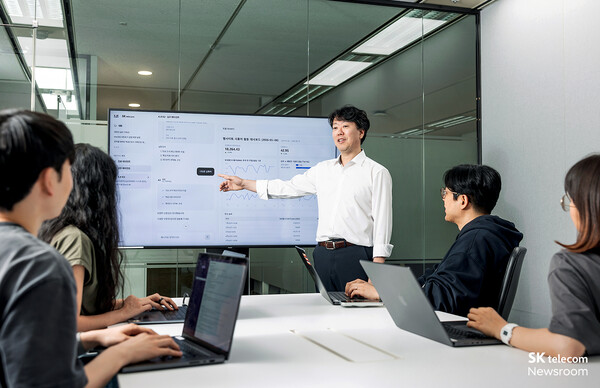
In an interview with SKT Newsroom on Monday, Kim Tae-yoon (김태윤), head of SKT’s foundation model, said the biggest change was shifting the focus from an AI that answers to an AI that plans and executes on its own. He outlined A.X K2’s features and its strategy for industrial applications.
A.X K2 is an ultra-large language model with 688 billion parameters. Compared with the previous model, A.X K1, it strengthened math and science reasoning, Korean-language knowledge, long-context understanding and AI agent capabilities.
Average performance across 14 domestic and overseas benchmarks improved by 32.2 percentage points from the previous model. Evaluations related to long-context understanding and AI agents improved by about 83.9 percentage points. Its score on the ultra-high-difficulty math benchmark “Apex” rose to 45.8 from A.X K1’s 1.0. It scored 97.1 on AIME26. It scored 80.5 on KMMLU-Pro, a Korean knowledge evaluation, and 91.6 on CLIcK, an evaluation of understanding Korean culture.
A.X K2 expanded the overall model size but kept the number of parameters actually activated during inference at 33 billion. The company said this was to increase reasoning ability while containing computing costs needed for real services.
Kim cited high-quality data, proprietary architecture and multi-stage reinforcement learning as factors behind the performance gains. Rather than simply increasing the volume of training, it improved reasoning by selecting and refining data that includes domain-specific expertise.
Sparse Gate Attention (SGA), developed in-house by SKT, is also a core technology of A.X K2. It was designed to process context quickly and stably in AI agent environments involving multiple rounds of conversation, tool calls and references to long documents.
When input length exceeds 32,000 tokens, advantages in throughput and latency become pronounced. At 120,000-token input, total token throughput improved by 67.7 percent from A.X K1. The company said this can improve response speed and service stability for tasks such as long conversations and analysing multiple meeting minutes and reports.
SKT has also developed derivative models that process images and audio as well as text. Its vision-language model, “A.X K2 VL Lite Preview”, uses an in-house vision encoder to analyse and structure manufacturing drawings and documents, charts and other materials.
In audio, it has built its proprietary audio language model “A.X K2 ALM” and “A.X K2 Raon Speech”, jointly developed with Krafton. Its strategy is to divide roles so a large model handles high-difficulty reasoning while a lightweight model processes detailed tasks in industrial settings.
SKT will pursue demonstrations of manufacturing-specialised AI agents with steelmaker KG Steel and auto parts maker Connec. The approach is to learn from past defect cases on production lines and, when problems occur, analyse causes and guide corrective measures. It will also connect a lightweight model to SK hynix’s in-house AI tool “LLM Chat” to support uses such as semiconductor knowledge search and information organisation.
For security-sensitive areas such as defence and the public sector, it will apply an on-premises environment isolated from external networks. It will conduct specialised training on internal networks without taking confidential data from institutions and companies outside or reflecting it in common model training.
SKT is preparing to supply A.X K2 after providing a lightweight version of A.X K1 to the Ministry of National Defense. It is also pursuing the application of security services such as real-time voice phishing detection and phishing blocking using an audio language model.
A.X K2’s weights and inference code will be released under an Apache 2.0 licence. It will maintain a free licence policy so developers and startups can use it commercially without restrictions, and will also support application programming interfaces, or APIs, and model optimisation.
SKT plans to scale up a follow-on model to a parameter count in the trillions. It will strengthen agent reinforcement learning and cyber security capabilities and study next-generation model structures with Seoul National University, KAIST and Krafton. With Rebellions, it will pursue running models based on a domestic neural processing unit, or NPU, and demonstrations of commercial services.
Kim said A.X K2 is a model with an understanding of the Korean language and the domestic industrial environment, along with data sovereignty, security and openness. He said it would evolve beyond an answering AI into a working AI to create value people can feel in industrial sites and daily life.
 Jin-ho Lee
jhlee26@d-today.co.kr
Jin-ho Lee
jhlee26@d-today.co.kr