
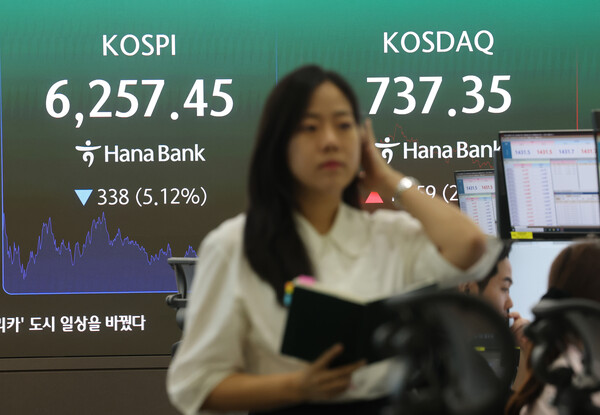
[Digital Today reporter Sangyeob Oh] After falling more than 22 percent in July and then posting its biggest rebound on record, South Korea's KOSPI slid more than 5 percent again on the first trading day of August. Foreign and retail trading directions also flipped in a single session, prompting analysis that it is too early to judge a rebound driven by oversold conditions as a trend reversal.
On Aug. 3, the KOSPI closed at 6,257.45, down 338.00 points, or 5.12 percent, from the previous session. It gave back part of the gains just one session after rising 1,001.89 points, or 17.91 percent, to 6,595.45 on July 31. In contrast, the KOSDAQ closed up 2.44 percent at 737.35, diverging from the KOSPI's move.
The KOSPI fell 22.19 percent on a monthly basis to 6,595.45 on July 31 from 8,476.48 on June 30. It posted the biggest daily gain on record on the last trading day of July, but it was not enough to offset the monthly decline.
The first variable for August is foreign investor flows. On July 31, foreigners posted a net purchase of domestic stocks totaling 8.7709 trillion won, combining regular trading hours and the alternative exchange Nextrade, a record. Individuals posted a net sale of 10.3834 trillion won the same day.
On Aug. 3, however, foreigners posted a net sale of 2.8429 trillion won and institutions a net sale of 1.9477 trillion won on the main board. Individuals posted a net purchase of 4.6532 trillion won, taking the supply sold by foreigners and institutions. The flow structure, in which foreigners bought what individuals sold during the sharp drop, flipped again in the opposite direction.
Stability in the won-dollar exchange rate is also cited as a variable needed for a recovery in foreign buying. The won-dollar rate fell to 1,424.0 won on July 31 from around 1,550 won in early July. It closed at 1,429.8 won on Aug. 3, up 5.8 won on the day, but remains lower than in early July.
Even so, analysis says that won strength may be a necessary condition for foreign buying but not a sufficient one, as foreigners returned to net selling on the day. It said confidence in semiconductor earnings, the direction of U.S. interest rates and global investors' appetite for risk assets also need to recover.
Brokerage firms are placing more weight on the possibility of a gradual recovery after establishing a bottom rather than a sharp additional drop. They cite that profit forecasts for KOSPI companies have not deteriorated as much as stock prices, and that deleveraging in single-stock leveraged products has also progressed substantially.
According to Mirae Asset Securities, net asset value of domestically listed single-stock leveraged exchange-traded funds fell to 8.6 trillion won recently from 16.3 trillion won on June 25. With both trading value and market influence of leveraged products declining, it said volatility is passing its peak.
Some also say it will be hard to expect a V-shaped rebound like during the COVID-19 period. Unlike the past, when rate cuts and large-scale liquidity supply accompanied the rebound, there remains the possibility of higher U.S. rates and concerns over the profitability of artificial intelligence (AI) investment.
Shinhan Investment Corp said only the price-to-earnings ratio has fallen to around 5 times while 12-month forward earnings per share (EPS) remain intact, and assessed the decline as a "trust adjustment" in earnings forecasts rather than a drop in profits. It suggested a three-month fair range of 6,500 to 8,300 and saw around 7,200 as the first resistance zone.
KB Securities suggested an expected KOSPI range of 5,500 to 8,000 for August. Hana Securities cited stability in U.S. short-term rates and a shift back to net foreign buying as key conditions for a rebound. After a sharp index drop, sectors that led the previous bull market are likely to lead the rebound, and whether the decline in semiconductors eases is also important, it said.
How much government and financial investment industry measures on single-stock leverage reduce volatility is also a key issue. From July 31, retail general investors must hold 30 million won in a basic cash deposit to newly or additionally buy domestic or overseas single-stock leveraged products. Substitute securities such as stocks, ETFs and bonds are not recognized as deposits.
Financial authorities are also reviewing a plan to set individual investment limits to manage investment 규모, and measures such as mandatory paper trading and charging costs for excessive trading. A cap of within 20 percent of an individual's total investment amount was presented as an example, but specific limits and the implementation timing have not been decided.
A plan is also being pursued to establish a legal basis to lower leverage multiples or restrict trading if market volatility expands sharply. The financial investment industry decided to spread rebalancing trades that were concentrated near the close to intraday trading and to manage trading volumes by liquidity providers (LPs).
These measures can ease leveraged products' tendency to amplify market moves, but it will be difficult to remove volatility arising from semiconductor earnings, foreign flows and U.S. interest rates. In August, there is a need to check whether leveraged ETF shares, margin loan balances, and foreign spot and futures trading stabilize together.
Minkyu Kim (김민규), an analyst at KB Securities, said, "Accept that a bottom has come, do not reduce exposure, but there is no need to rush to increase exposure." He added, "There needs to be a process of confirming clues of rate stability and a rebound."
 Sangyeob Oh
yub@d-today.co.kr
Sangyeob Oh
yub@d-today.co.kr