
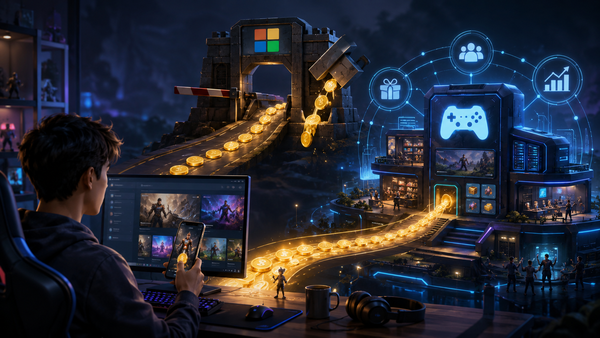
South Korea's game industry is speeding up the build-out of in-house payment systems that sell products directly to users without going through app markets. The aim is to improve profitability by cutting app market fees while directly securing payment data and user touchpoints.
According to the industry on Monday, Krafton completed a strategic investment in global game commerce infrastructure company Neon Commerce on July 23. Neon Commerce raised a total of $13 million in its Series A round, with Andreessen Horowitz (a16z) and Renegade Partners participating.
Neon Commerce supports game companies with web stores they operate directly, payments, and responses to country-by-country taxes and regulations. Krafton plans to use it to reduce the time and cost burden of developing payment infrastructure from scratch while expanding direct touchpoints with global users.
This push to internalise payment infrastructure is not limited to Krafton. Major game companies such as NC, Netmarble, Nexon and Smilegate are also expanding payment routes outside app markets, centred on PC launchers and web stores. Payment systems are shifting from an add-on to game services to core infrastructure directly tied to profitability and user management.
Up to 30 percent fees put pressure on profitability.
The most direct reason game companies are expanding in-house payments is app market fees. When they sell items and products through app markets, they must pay up to 30 percent of revenue to platform operators. The structure means fees rise as sales grow.
By contrast, fee rates for in-house payments linked to payment gateway providers, or official web stores, remain in the 3 to 8 percent range. Simply moving the payment route outside app markets can sharply increase the amount game companies keep from the same sales.
The trend is also visible in the numbers. Netmarble is pushing simultaneous PC launches and expanding web stores by game. Its fee payout ratio against revenue fell from 41.3 percent in 2020 to around 30.8 percent recently, and platform fees paid in the first quarter of this year were 200.9 billion won, down 8.3 percent from a year earlier. Other factors such as changes in the sales mix and the share of sales by platform may also have played a role, but it is possible to interpret the higher share of in-house payments as having helped reduce the fee burden.
With new game development costs and labour costs rising, in-house payments are seen as a way to improve profitability by cutting platform fees without additional sales growth.
App market operators' fee policies are also changing. Google applied a policy first to the United States, Europe and Britain on June 30 that charges service fees of 15 percent and 20 percent, respectively, for transactions by newly installed and existing installed users, and waives additional fees for external web payments. It plans to introduce the policy in South Korea and Japan by Dec. 31.
One industry official said that even if Google cut fees, a certain level of burden remains as long as transactions go through app markets. The need for in-house payments will not diminish, the official said, given that companies can design prices and benefits directly.
Beyond cost cuts, the aim is also to secure control over data and marketing.
The purpose of expanding in-house payments is not limited to reducing costs. Game companies can directly secure purchase information generated in their web stores and use it for product operations and marketing. By analysing which users bought which products and how discounts and points affected payments, they can run tailored promotions for individual users.
NC supports PC payments for mobile games such as 'Lineage M' and 'Lineage2M' through Purple, while also offering discounts for simple payment services. Netmarble encourages web payments by crediting 10 percent of the payment amount as its own points in the web store for 'Solo Leveling: ARISE'. Nexon provides rewards to in-house payment users through 'Nexon Plug', and Smilegate has secured a PG licence based on 'Stove' and its unit Stove Pay and operates a points accumulation programme. A common approach is to return part of the savings from fee cuts to users while shifting payment routes to in-house channels.
In-house payments can also be seen as a process in which game companies take back transaction leadership that app markets once held. By directly managing payment processes and purchase information, companies can run product sales, marketing and user management policies without relying on external platforms.
The key is not building the system, but moving users.
In-house payments do not have the same effect for every game company. Even if a company builds a web store, fee savings are limited if users do not choose external payments over existing app markets. Large game companies with well-known IP and loyal users can more easily steer users to official communities and PC launchers, but small and mid-sized developers must shoulder the burdens of attracting users, marketing, security, refunds and customer support on their own.
When expanding overseas, companies must also respond to country-specific payment methods and currencies, taxes and personal data protection rules. Efforts are also emerging to lower these barriers to entry. Game companies are moving to reduce resource burdens by using specialist companies such as Neon Commerce or external payment platforms rather than building infrastructure directly. Nexthrust's D2C web shop platform, 'Cross Game Hub', introduced in June, is in the same context. It supports game companies lacking dedicated development staff so they can run everything at once, from product registration to payments and sales analysis.
Ultimately, the success of competition over in-house payments depends not on whether systems are in place but on whether users actually move to them. The key is how consistently companies provide better benefits and convenience than app markets, and trusted security.
Another official said that the expansion of in-house payments, which began as an attempt to cut fees, is now shifting into competition to directly secure user data and payment touchpoints. The gap between game companies that establish in-house payment systems first and those that do not will widen further, the official said.
 Ho-jung Lee
lhj@d-today.co.kr
Ho-jung Lee
lhj@d-today.co.kr