
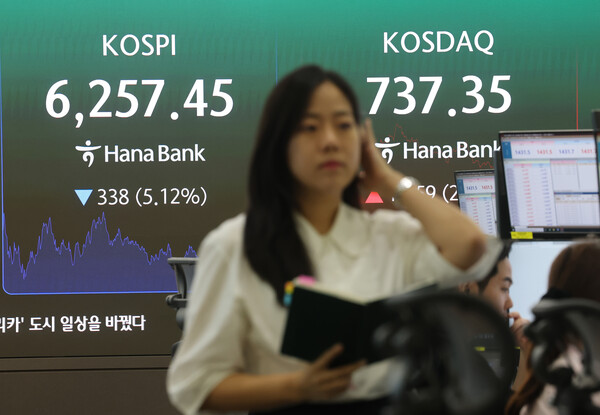
The KOSPI, which posted its biggest-ever one-day surge on the last trading day of last month, fell more than 5% on weakness in large semiconductor shares. The Kosdaq, meanwhile, showed strength strong enough to trigger a buy sidecar during the session and ended up more than 2%, leaving the two markets moving in opposite directions.
On Aug. 3, the KOSPI ended down 338.00 points, or 5.12%, at 6,257.45. The index opened at 6,358.27 and widened its losses, at one point sliding to 6,223.29.
In the main stock market, individuals bought a net 4.65 trillion won. Foreigners and institutions sold a net 2.83 trillion won and 1.95 trillion won, respectively.
That contrasted with the flow on July 31, when foreigners posted the largest net buying of domestic stocks on record and pushed the KOSPI up 17.91%.
Top semiconductor shares by market capitalisation led the index lower. Samsung Electronics closed down 8.76% at 239,500 won, and SK Hynix ended 8.79% lower at 1,567,000 won.
Elsewhere, SK Square fell 1.25%, while Samsung Life Insurance and Samsung Biologics slid 7.70% and 4.18%, respectively.
Samsung Electro-Mechanics, by contrast, ended up 3.42% at 1,181,000 won, and Hyundai Motor rose 1.29% to 393,000 won. KB Financial Group also gained 0.59%. LG Energy Solution fell 3.66%.
The Kosdaq rose, moving in the opposite direction to the KOSPI. It ended up 17.59 points, or 2.44%, at 737.35.
As early gains quickly accelerated, a buy sidecar was triggered at 10:28:08 a.m. At the time, Kosdaq 150 futures were up 6.41% from the previous session, and the Kosdaq 150 was up 3.13%.
The Kosdaq gave back part of its gains after the sidecar was triggered, but held its strength through the close.
In Seoul's foreign exchange market, the won-dollar exchange rate stood at 1,431.80 won, down 8.20 won from the previous session.
In the securities industry, some expected short-term profit taking to emerge as the KOSPI surged 17.91% in a single day on July 31.
Han Ji-young (한지영), a researcher at Kiwoom Securities, said the July 31 surge was likely more than a simple technical rebound and that more weight should be placed on a recovery process that raises the low points going forward. She forecast that U.S. employment and manufacturing indicators, corporate earnings and foreign flows would determine whether the rebound continues.
 Oh Sang-yup
yub@d-today.co.kr
Oh Sang-yup
yub@d-today.co.kr