
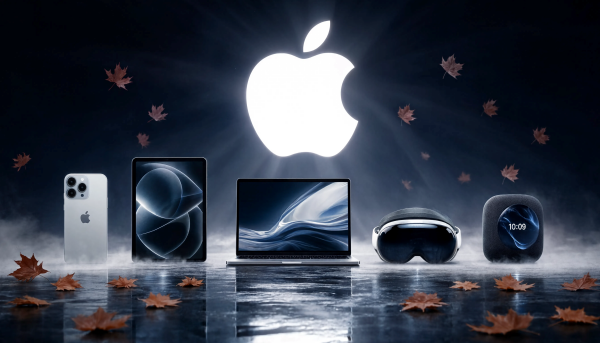
[Digital Today reporter Jinju Hong] Apple may unveil a large number of major new products this autumn that have been delayed, expectations have emerged. Changes are expected across the product range, from the first foldable iPhone to a touchscreen MacBook, a next-generation Apple TV and smart home devices.
According to IT outlet 9to5Mac on July 31 (local time), Apple’s new product candidates include the iPhone Ultra, known as the first foldable iPhone, a new Apple TV 4K, a touchscreen MacBook Ultra (or MacBook Pro), HomePod mini 2 and HomePad.
The product drawing the most attention is Apple’s first foldable smartphone. The possibility of Apple entering the foldable smartphone market has been raised steadily since Samsung Electronics opened the market in 2019.
Apple is known to have focused on improving the screen crease issue and durability, seen as the biggest weaknesses of existing products, in its first foldable iPhone. Analysis says it aimed to minimise traces at the fold by applying a new hinge structure and to design it to withstand long-term use. The outlet assessed that related technology has now reached a level that can implement a “highly complete foldable product.”
A generational update is also expected for the living-room device Apple TV 4K after a long time. The current model has had no successor since its launch in the autumn of 2022. A 2025 launch had been discussed, but the schedule is known to have slipped due to delays in Apple’s development of next-generation Siri AI. As Siri AI features have been applied in earnest in iOS 27, the possibility has grown that the new Apple TV 4K will also appear highlighting an improved voice assistant experience.
In the smart home lineup, HomePod mini 2 and HomePad are in focus. HomePod mini has had no major hardware change since its first release in 2020, apart from adding colours. The next-generation HomePod mini 2 is expected to include a new chip to run Siri AI, improved sound quality and new colours.
HomePad, which may be unveiled alongside it, is a smart home hub product equipped with a display. Some also know it as “HomePod Touch,” and it was reported that Apple is developing it as a key device to expand its smart home market.
In the Mac lineup, support for a touchscreen is cited as the biggest change. Apple has maintained a negative stance toward adding touch functions to Macs. But as it expands a usage experience that combines a keyboard and trackpad with the iPad, assessments say the boundary between Macs and iPads is gradually blurring.
The touchscreen MacBook being discussed could be released under the MacBook Ultra or MacBook Pro brand. As features that assume touch input have recently been identified within macOS, observations are emerging that Apple could revise its existing strategy. The outlet said macOS includes changes that consider a touch environment, such as pull-to-refresh, direct touch input for Sidecar and expanded markup functions.
This new product lineup is significant in that it marks the resumption of releases for products Apple has long prepared. The foldable iPhone shows a challenge to a new form factor, the touch MacBook changes the Mac usage experience, and HomePad and Apple TV point to a strengthening smart home strategy.
Some products, however, could still see changes to development schedules. In particular, Siri AI completeness is cited as a key variable that will determine actual release timing and the product experience.
Attention is focused on whether Apple’s hardware announcements this autumn will go beyond adding new products and become an opportunity that signals strategic changes across iPhone, Mac and smart home.
 Jinju Hong
hongjj@d-today.co.kr
Jinju Hong
hongjj@d-today.co.kr