
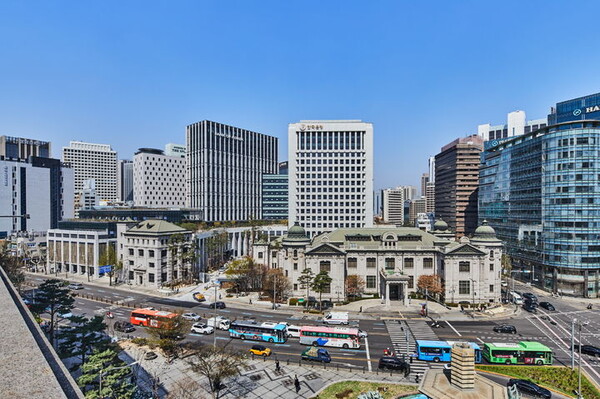
[DigitalToday reporter Sangyeob Oh] The Bank of Korea said South Korean stocks have seen a steep correction due to worries about a slowdown in artificial intelligence (AI) investment and foreign selling, but a strong earnings outlook for semiconductor companies could limit further declines.
In a work report submitted on Tuesday to the National Assembly's Strategy and Finance Committee, the Bank of Korea said, "Favourable fundamental conditions, including forecasts of large operating profits at semiconductor companies, are expected to help limit downward pressure on domestic stock prices."
The central bank said South Korean stocks have recently undergone a sharp correction due to worries about a slowdown in AI investment and heavy net selling by foreign investors.
It said large-scale net selling by foreigners has been concentrated since May, and stock price swings have widened as leveraged investment has also increased.
It said this added a warning on leveraged investment compared with an earlier work report this month that cited end-of-half portfolio adjustments as a key driver of volatility.
At the time, the central bank said the likelihood of domestic stock prices shifting into a sustained downtrend was limited, as profit estimates for semiconductor companies were being raised and the government was continuing reforms to capital market systems.
It said the stock market was likely to respond sensitively going forward to external variables including the outlook for the AI industry, changes in monetary policy in major countries and global capital flows.
On monetary policy, it reaffirmed its view that it was necessary to maintain a rate-hiking stance.
The central bank said, "The timing and pace of additional hikes will be decided while checking the degree of inflationary pressure, the flow of improvement in the economy and financial stability conditions."
The Bank of Korea raised its benchmark interest rate by 0.25 percentage point to an annual 2.75 percent from 2.50 percent as of July 16.
It cited strengthening growth on the back of a semiconductor upturn, an inflation rate that exceeds the target level and continued financial stability risks as reasons for raising the benchmark rate.
The central bank said, "As growth improves due to the semiconductor upturn and other factors, inflation is expected to remain above the target level for a considerable period, and risks to financial stability are also continuing."
 Sangyeob Oh
yub@d-today.co.kr
Sangyeob Oh
yub@d-today.co.kr