
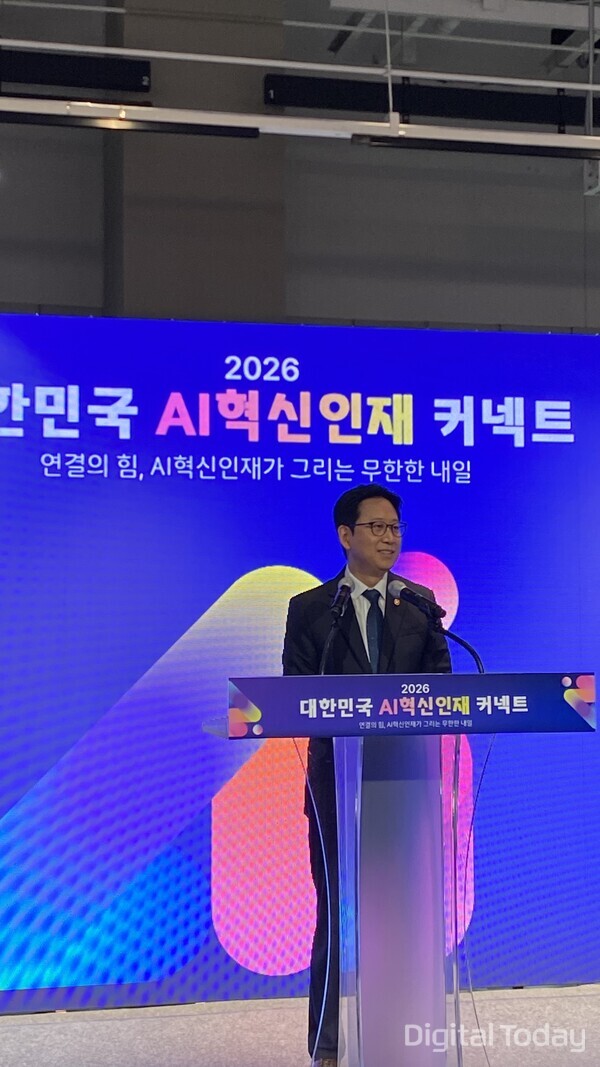
The government will strengthen AI education and industry-academia cooperation to train talent to support the three mega projects worth 4.5 quadrillion won. It aims to link education and research with industrial demand so AI research does not remain at university theory but leads to results at companies. It also plans to create an environment where talent can grow in South Korea and receive appropriate treatment.
Deputy Prime Minister Bae Kyung-hoon (배경훈), who also serves as minister of science and ICT, said at the 2026 Korea AI Innovation Talent Connect event held at COEX in Seoul on Tuesday that large-scale AI investment must be backed by talent development for it to translate into industrial competitiveness.
Bae described the three mega projects the government is pursuing in AI semiconductors, AI data centres and physical AI as efforts to ensure South Korea has top-level AI capabilities and prepares for the full-fledged AI era. He said the announced scale of the projects alone amounts to 4.5 quadrillion won.
He said the government is pushing follow-up plans step by step so the initiative does not end as a simple declaration. He added it is also building a foundation for cooperation to attract overseas capital, in addition to investment by domestic companies and the government.
Bae said he discussed practical cooperation measures between global big tech firms and South Korean companies at an AI event recently held in the United States. He said investment plans worth $950 billion were announced in AI semiconductors and data centres, and specific cooperation measures to carry them out were also discussed.
He said South Korea should create various industries and services and build a foundation to export them to global markets by applying AI to areas where it can perform well, centred on physical AI. He said the government sees the three mega projects as an important starting point that signals the beginning of the AI revolution.
He said investment and preparation over the next 3 to 5 years could determine South Korea's future for the next 30 years.
Bae stressed that fostering AI talent is important, along with investment, the research environment and building a corporate ecosystem.
He said South Korea needs to create an environment in which talent can freely conduct research and produce good results in the country for it to become one of the three leading AI powers. He said he has worked with AI graduate schools on how to nurture talent and how they can move on to their next roles after graduation.
He said there was a period when the flow of AI talent development slowed somewhat due to avoidance of engineering and a preference for medical schools, but interest in related fields is rising again as the AI industry grows.
Bae said the world is also showing interest in South Korea's AI and proposing cooperation. He said cases of talent overseas coming to South Korea are also increasing.
He said the government will work with companies, research institutes and universities to create an environment where talent can produce good results in South Korea, be properly treated and build the future.
He also stressed the need to link university research results to industrial sites through industry-academia cooperation.
Bae said AI should go beyond remaining only in theory and move toward operating in corporate sites and producing actual results. He said synergies can be achieved only when AI is connected to other academic disciplines and industrial fields.
He said he will support universities, industry and the research sector in nurturing students as AI talent and in creating a culture that allows them to settle in South Korea. He added that if there are shortcomings in the government's efforts, people in the field should actively offer their views.
The Ministry of Science and ICT will hold the 2026 Korea AI Innovation Talent Connect at COEX in Seoul from Tuesday to July 31. About 1,000 people will attend, including graduate students and researchers participating in government-backed AI talent programmes and corporate officials, such as AI and AX graduate schools, AI Convergence Innovation Graduate Schools, the AI Star Fellowship and programmes to foster leading generative AI talent.
The ministry will discuss with industry, academia and research stakeholders the talent capabilities needed in key fields such as data centres and physical AI, the type of talent industry seeks, and cooperation measures between universities and companies. Based on opinions from the field, it also plans to prepare an AI Talent Development Support Strategy containing directions for AI talent development and support systems.
 Seulgi Son
sageson@d-today.co.kr
Seulgi Son
sageson@d-today.co.kr