
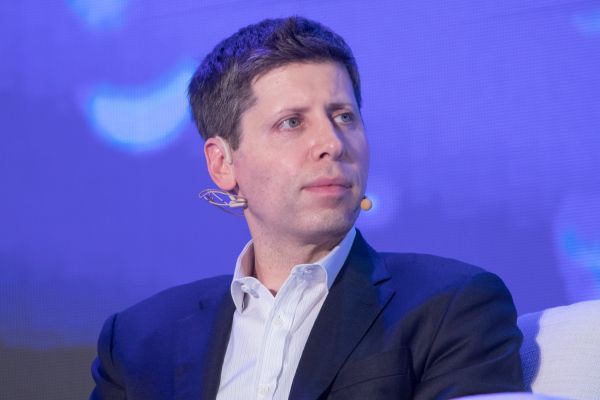
Sam Altman (샘 알트먼), chief executive of OpenAI, took a negative view of a model that replaces the CEO role with AI. He judged that major corporate decisions must ultimately be connected to someone who bears responsibility, and that users and the market want human managers more than an AI CEO.
Business Insider reported on July 28 that Altman said on the podcast “Invest Like the Best” that people do not want an AI CEO.
Altman in particular stressed that the party responsible for management must be clear. Citing his own role, he said, “The world wants to know who is responsible for the company’s decisions, and who can be held accountable when a wrong decision is made,” adding, “People do not want an AI CEO that much.”
The remarks also connect to a change in Altman’s prior view. He appeared on another podcast in November 2025 and said it would be his failure if OpenAI could not become the first major company to have an AI CEO. At the time, he put weight on the possibility that AI could rapidly change even management structures, but this time he has shifted his view toward human accountability and trust being more important.
Altman also cited human preferences as a reason AI has not shaken up the economy as much as expected. He said, “People feel trust and enjoyment in working with others,” and judged that even if people can already encounter roles similar to AI consultants, AI sales staff and AI engineers, most still prefer interaction with people.
He then said he holds the same view. “In most work, I much prefer building relationships with people than with AI,” he said. The remarks were seen as resting on a view that even if AI performance improves, human relationships, judgment and responsibility are separate domains.
This perspective also carried into his assessment of creative fields. Altman said that even if AI models can create excellent images, people still place value on art made by humans. After mentioning a joke that a work’s value depends on the signature, he said, “People want to know who is behind it,” explaining that even when reading a novel, people ultimately take interest in the creator themselves.
Against this backdrop, Altman also partly revised his earlier forecast that AI would immediately bring large-scale job displacement. He had previously said AI could eliminate “entire categories of jobs,” but recently said he is happy to accept that he was wrong about the short-term shock to entry-level jobs. He said social tendencies to preserve humans and to value humans highly are acting as factors that slow the pace of technology diffusion.
The debate is already spreading across the broader content market. Like other figures in the industry, Altman also tried to explain uniquely human roles with concepts such as “taste” or “judgment,” but he judged that existing words may not be sufficient.
He said areas where AI lags behind humans will continue to shrink, but the ability to make judgments where only people show strength still remains. “The world may need a new word to describe the kind of judgment that people do very well but AI finds difficult,” Altman said. It was a moment that shows AI competition is shifting from performance upgrades to issues of accountability, trust and human judgment.
 Yoonseo Lee
yslee@d-today.co.kr
Yoonseo Lee
yslee@d-today.co.kr