
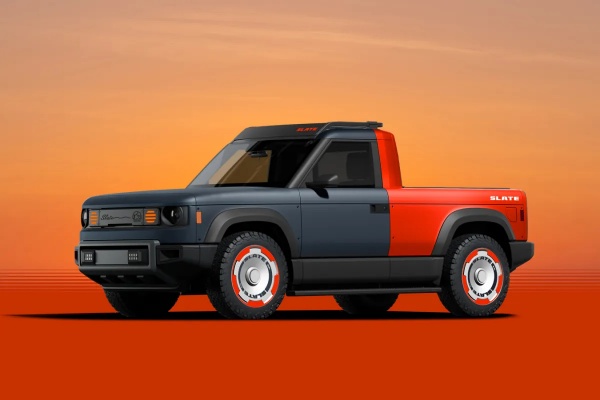
[DigitalToday reporter Jinju Hong] U.S. electric vehicle startup Slate has changed the battery for its electric pickup truck due for release this year from a ternary (NMC) battery to lithium iron phosphate (LFP). It also switched its battery supplier from SK On to Gotion, a strategy aimed at both price competitiveness and production efficiency.
On June 24 local time, EV outlet InsideEVs reported that Slate has decided to use LFP battery packs produced by Gotion at its Illinois plant for mass-production models instead of the NMC batteries it considered when it unveiled the vehicle last year.
The decision is seen as the result of overlapping factors including price competitiveness and supply-chain reshuffling. Gotion’s plant is close to Slate’s assembly plant in Indiana, which the company judged would cut logistics costs and improve production efficiency.
Chris Barman (크리스 바먼), Slate’s vice president of vehicles, said that early in development in 2022 there were not many LFP batteries available to choose from in the United States. He explained that at the time it was difficult to meet the battery-origin requirements for federal EV subsidies, and production capacity was not sufficient. Slate said it had continued talks with Gotion, but had to consider different battery configurations because of U.S. federal EV tax credit rules.
The situation changed after the U.S. Congress abolished an EV tax credit of up to $7,500 through the so-called One Big Beautiful Bill Act (OBBBA). Barman said the LFP supply environment has become much better than before and policy changes have widened battery options.
With the removal of tax benefits, the original target of a selling price below $20,000 has effectively become difficult. Slate set the base price of the mass-production model at $24,950 (about 38.6 million won).
The battery change also affected vehicle performance. The newly applied 65 kWh LFP battery pack costs less to make than the previous plan, and uses a cell-to-pack structure that stacks prismatic cells directly into the pack without modules to improve space utilization.
As a result, the vehicle secured a range of 205 miles (about 330 km), a sharp increase from the 150 miles (about 241 km) announced last year. Barman said it can offer a longer range while maintaining the target price range.
Peak output, however, fell to 181 horsepower from 201 horsepower. That is because LFP batteries have lower voltage than NMC. Acceleration from a standstill to 60 miles per hour (about 97 km) remains 8 seconds, unchanged from before.
Slate engineers said LFP can have more advantages in vehicles used for shorter driving ranges. They said LFP batteries are suitable for daily driving because performance degradation is relatively limited even with repeated 100 percent full charging and deep discharging.
The product strategy was also simplified. Slate had considered a large-capacity battery option capable of 240 miles of driving, but the new LFP battery fills most of the underbody space, making additional battery options effectively difficult. Eric Kuiper (에릭 카이퍼), Slate’s chief engineer, said the current single configuration was judged to have found an appropriate balance and that it plans to decide future product strategy after watching market response.
Slate began taking pre-orders on the day and plans to begin full-scale mass production in the fourth quarter of this year. Whether Slate, with its low-price strategy and single LFP battery, can prove competitiveness in the U.S. market with a $24,950 price tag and 205-mile range is expected to be a key point to watch.
 Jinju Hong
hongjj@d-today.co.kr
Jinju Hong
hongjj@d-today.co.kr