
GitHub has introduced a feature that limits the number of pull requests (PRs) external users can submit, to address a surge in low-quality contributions after the spread of generative artificial intelligence (AI). The move is seen as a way to keep outside participation in open-source projects while cutting maintainers' review burden and automation costs.
On June 18 local time, online media outlet GIGAZINE reported that GitHub recently added a feature allowing repository administrators to limit the number of simultaneously open pull requests by users who do not have write access.
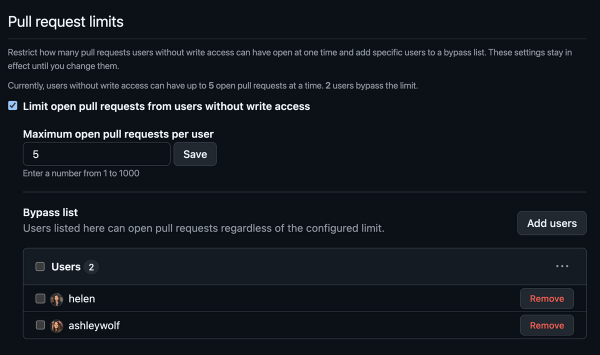
The core of the feature is to prevent situations in which a specific user submits large volumes of pull requests in a short period and fills the review queue, without completely blocking outside contributions. Administrators can set, for each repository, how many pull requests an external user can keep open at the same time.
Once a user reaches the set cap, the user cannot submit a new proposal until an existing pull request is merged or closed. GitHub explained that the feature is a response to the rapidly growing problem of low-quality contributions after the emergence of generative AI. It said that as AI coding tools make it relatively easy to generate code changes, pull requests that are less relevant to projects or lower in quality have surged.
Open-source project maintainers must check each submission to see whether the code aligns with the project’s purpose, follows contribution guidelines and whether the author is willing to respond to feedback.
As AI-based code generation spreads, criticism has continued that this review burden is growing as well. GitHub already introduced features in February to respond to similar problems by disabling pull request submissions or restricting them so that only collaborators can submit.
But those approaches have also been criticised for effectively blocking outside contributions. Concerns were raised that they could make it harder for new participants to contribute to a project for the first time. The new cap feature is seen as a compromise aimed at finding a balance between outside participation and operational efficiency. GitHub described it as "an option that can keep the pull request submission channel while suppressing mass posting".
Exceptions were also put in place for trusted contributors. Administrators can add specific users to a trusted contributor list and exclude them from the cap. That allows more pull request submissions from users who have consistently made high-quality contributions, even without granting write access.
The move is directly tied not only to maintainers’ workload but also to operating costs. As pull requests increase, usage of continuous integration (CI) systems that run automated tests and build verification also rises. GitHub said the new feature reduces unnecessary code reviews and CI work, helping maintainers focus more on valuable contributions. The company described the feature as "the first step to protect maintainers' time".
GitHub is also reviewing features that would automatically ease restrictions based on factors such as when an account was created, the number of previously approved pull requests, or whether a user belongs to a specific organisation. It also presented follow-up tasks including applying a similar cap to issue creation and measures to address mass posting across multiple repositories.
In the open-source industry, cases are already increasing in which projects limit outside code contributions or tighten review standards after the emergence of generative AI.
The industry sees the move as an attempt to preserve the core open-source value of outside participation while providing minimal operational controls suited to the AI era.
 Jinju Hong
hongjj@d-today.co.kr
Jinju Hong
hongjj@d-today.co.kr