
The government and industry will work to build a “K-physical AI full stack” linking homegrown artificial intelligence (AI) semiconductors and models with software, robots, communications networks and data centres. They will shift the existing framework, which focused on policy proposals and collecting opinions, into an execution-focused platform that drives technology development and on-site deployment.
The Ministry of Science and ICT held the launch ceremony for the second term of the Physical AI Alliance on Thursday at the Plaza Hotel in Jung-gu, Seoul, with about 200 attendees from companies, universities, research institutes and associations in the physical AI sector.
Physical AI is a technology that goes beyond AI that creates content in digital space to one that recognises and judges the real world and takes direct action. It combines AI with physical devices such as robots, autonomous driving and smart factories to carry out tasks in response to changes in the surrounding environment.
FROM DISCUSSION-FOCUSED FIRST TERM TO “EXECUTION PLATFORM”
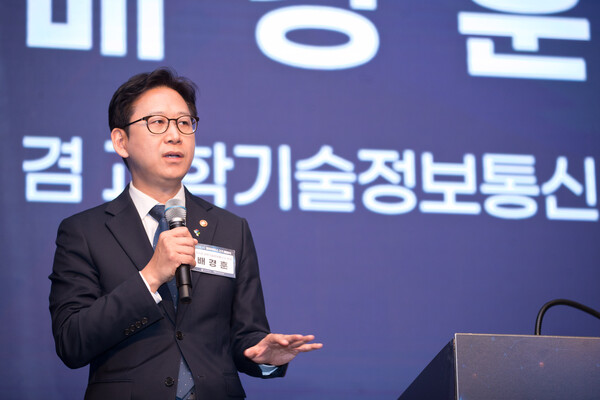
The alliance's second term focuses on linking its tasks to national projects and demonstration programmes. Bae Kyung-hoon (배경훈), deputy prime minister and science and ICT minister, and Cho Joon-hee (조준희), chairman of the Korea AI and Software Industry Association (KOSA), will serve as co-chairs. Unification Minister Jeong Dong-young (정동영) and People Power Party lawmaker Choi Hyung-doo (최형두) will serve as special advisers.
The ministry launched the alliance's first term in September last year and derived 40 tasks based on industry demand and difficulties. The second-term alliance will compress the 40 tasks into three key projects. The core items are building a Korean-style physical AI full stack platform, establishing training centres and enacting a Physical AI Promotion Act.
Jung Soo-jin (정수진), head of the Regional AX Division at the National IT Industry Promotion Agency (NIPA), said, “The Physical AI Alliance is a national project executed through a homegrown full stack, data and a promotion act.” She added, “The second term will shift into an execution-based national project discovery platform that spreads independent homegrown technology across industrial sites.”
The Korean-style full stack platform will focus on building a standard ecosystem and development tools that reduce dependence on Nvidia's CUDA and allow large action models (LAM) and foundation models to run on homegrown neural processing units (NPUs). It will build training centres that produce training action data by combining teleoperation, which remotely controls real robots to collect data, with a digital-twin simulator. The government will pursue plans to establish specialised hubs in five regions nationwide. The Physical AI Promotion Act is a law designed to promote relevant technology development and commercialisation and support fostering the industrial ecosystem.
In an opening address, Bae stressed that South Korea's physical AI technology must move beyond the global top three and establish itself as the top player. “Through the second term of the alliance, we will properly prepare for the era of physical AI,” Bae said. “We will 반드시 set up a data 확보 framework for physical AI and lay the groundwork to move to the next stage,” he said.
LINKING AI CHIPS TO ROBOTS AND NETWORKS, AIMING FOR A TOTAL PLATFORM
The alliance's second term aims for a total solution platform that covers not only models but also semiconductors and data, software, robots, computing infrastructure, communications networks and security. With the goals of “self-reliance in homegrown technology” and “domain expansion”, it integrated the existing 10 subcommittees into three divisions: K-physical AI full stack, vertical industry bridge and foundational governance.
Under each division, it will set up action groups by field, including AI models and data, world models, robots, manufacturing, healthcare, autonomous driving and logistics, and standards and safety, to identify projects. Cooperation, previously limited to manufacturing, will expand to all industries, including logistics, agriculture, healthcare, defence, administration and disaster safety. In manufacturing, it will link with the Ministry of Trade, Industry and Energy's M.AX alliance to connect technology development results to on-site demonstration and spread. The event also held appointment ceremonies for division chairpersons, members and action group leaders.
LINKING GOVERNMENT R&D AND POLICY FINANCE, SUPPORTING COMMERCIALISATION
Shin Jin-woo (신진우), a KAIST professor who delivered a presentation, stressed the importance of benchmarks and simulation technology, real-data infrastructure and demonstration testbeds. “We need to secure leadership in robot hardware and data standards and set a safety governance framework at the pan-ministerial level,” Shin said. “We must cultivate talent and engage in research and development with a long-term perspective,” he suggested.
The government will link outstanding projects identified by the alliance to new research and development (R&D) and demonstration programmes. It will also use the Jeonbuk AX demonstration cluster to provide companies with early demonstration opportunities, and connect on-site confirmed regulations to a regulatory sandbox. For promising projects, it will link policy finance such as the National Growth Fund, the AI Innovation Fund and the Korea IT Fund. It will also provide financial support such as loan interest rate reductions for outstanding companies. Using overseas hub centres, it will support local networking, participation in global exhibitions and overseas investment and market development.
Domestic leading companies also demonstrated physical AI technologies. Realworld showcased a technology in which two robots cooperate to package a computer mouse and place it at a designated location. Realworld's physical AI model, RLDX-1, scored 70.6 points in RoboCasa Kitchen, a global robot evaluation. In the GR-1 tabletop humanoid evaluation, it recorded performance 10.7 percentage points higher than Nvidia's Groot N1.6. Maum AI unveiled an autonomous intelligence module, MAIED, that recognises and judges the surrounding environment inside the robot without going through the cloud, and a quadruped robot called Jindobot.
Bae said, “To get ahead in the physical AI competition, we need to have both independent technological capabilities and a foundation for industrial diffusion.” He added, “We will operate it as a total solution platform that connects technology development results to real sites and feeds data and demand generated on-site back into technology development.”
 Jin-ho Lee
jhlee26@d-today.co.kr
Jin-ho Lee
jhlee26@d-today.co.kr