
The government will reorganise its national strategic technology framework into 55 technologies across 10 areas to respond to an artificial intelligence (AI) transition and economic security competition. It aims to secure technology at the world’s highest level by 2030 and take the lead in world-first technology by 2040.
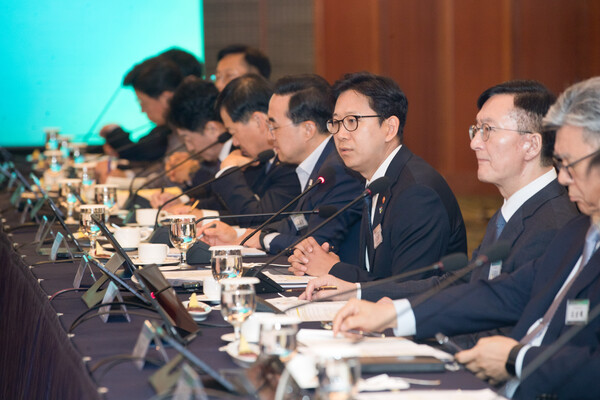
The Ministry of Science and ICT and the Office of Planning and Budget on Wednesday held the "NEXT Project Launch Event for Leading National Strategic Technologies" at a Lotte Hotel in Seoul. About 100 people attended, including major companies, universities, research institutes and officials from relevant ministries.
NEXT is an acronym for New, Emerging, and eXponential Technology. It refers to next-generation and emerging technologies that will lead new industries through exponential growth. Through the NEXT project, the government will link key R&D programmes and industrial and investment policies for each national strategic technology, and seek industrial leadership and a first-mover advantage in new markets.
The government has expanded R&D, investment and policy support based on the designation of national essential strategic technologies in 2021 and the National Strategic Technology Fostering Act, which took effect in September 2023. It will invest 8.6 trillion won in national strategic technology R&D this year.
Deputy Prime Minister Bae Kyung-hoon (배경훈), who also serves as science and ICT minister, said industry should present on-the-ground demand for technology and markets, universities should lead talent development and global joint research, and research institutes should strengthen their role as hubs for challenging R&D. He said the government would link industry-academia-research capabilities with R&D and financial, investment and policy support through the NEXT Alliance.
The national strategic technology framework will be reorganised into 10 areas and 55 technologies.
At the launch event, the government announced the NEXT national strategic technologies, which reorganise the framework around three core missions: leading the AI transition, trade and security leadership, and foundations for future innovation.
Reflecting changes in the global technology environment and views from industry, academia, research institutes and relevant ministries, it included promising technologies such as materials and energy, and intelligent power grids. It also reinforced areas such as defence semiconductors, which have grown in importance from a security perspective. It reorganised the framework into 55 technologies across 10 areas.
The science ministry and related ministries including the Ministry of Finance and Economy and the Ministry of Trade and Industry strengthened consistency across laws and regulations related to strategic technologies. They reviewed management systems for 513 technologies included in the National Strategic Technology Fostering Act, the Restriction of Special Taxation Act, the National Advanced Strategic Industries Act and the Industrial Technology Protection Act, and derived overlapping technology areas. Technologies included in all four laws will be designated as priority support areas, and the government plans to concentrate R&D investment, tax benefits and industrial fostering support depending on technology readiness levels and policy goals.
The government will 추진 a cross-ministerial project focused on new tasks to be launched from 2027, among the missions derived by sector under the NEXT framework. From next year, new missions will be pursued in 10 areas: AI; advanced robots and mobility; next-generation security and networks; innovative and future materials; future energy and nuclear power; quantum; semiconductors and displays; advanced bio; next-generation batteries; and aerospace and marine.
The project’s core programmes will be designated by the end of this year as "national strategic technology R&D programmes" under the National Strategic Technology Fostering Act. Designated programmes will be reviewed on a priority basis in the R&D budget allocation and adjustment process, and companies’ matching ratios for research funding will also be eased.
Industry, academia, research institutes and government will join forces as the NEXT Alliance is launched.
To reduce barriers between ministries and expand private participation during the project process, the government will build the NEXT Alliance in the second half of this year.
The alliance will consist of consultative bodies by strategic technology area and a project support team. The consultative bodies will include companies, universities, research institutes and companies holding strategic technologies, and will discuss project progress and items for institutional improvement. They will also pursue talent development, commercialisation and building an industrial ecosystem. Hong-rim Yoo (유홍림), president of Seoul National University, said it would pursue leading research that identifies challenging problems and seeks solutions to secure world-leading technology by 2030 and world-first technology by 2040.
The support team will expand participation by financial firms, investment institutions and venture capital firms, and designate a "dedicated agency for spreading research outcomes" to support technology commercialisation and the spread of outcomes. It will also strengthen international cooperation, including joint research with overseas institutions.
Relevant ministries will link to the project policy tools they hold, including core R&D programmes, intellectual property analysis and innovative procurement. The science ministry, the industry ministry, the climate ministry and the Korea AeroSpace Administration will 추진 R&D programmes, the intellectual property agency will provide IP analysis in strategic technology areas, and the procurement agency will support innovative procurement.
The government will establish a mid- to long-term investment strategy in the second half of the year and finalise a full project roadmap. It plans to manage results by project through the Special Committee on National Strategic Technologies and disclose progress later through a national strategic technology summit and other channels.
Bae said securing strategic technologies is essential for national survival. He said the government would also hold a launch event in the second half of the year and accelerate development of the NEXT national strategic technologies.
Planning and Budget chief Park Hong-geun (박홍근) said competitiveness in national strategic technologies can deliver results when corporate investment is combined with the research capabilities of universities and research institutes. He said the government would build a stable investment foundation in national strategic technology areas and create conditions to take on future technologies.
He also said the country is in the middle of an era of technology hegemony in which technology is national competitiveness. He said he hoped today would become an exciting starting point for future growth engines.
 Jin-ho Lee
jhlee26@d-today.co.kr
Jin-ho Lee
jhlee26@d-today.co.kr