
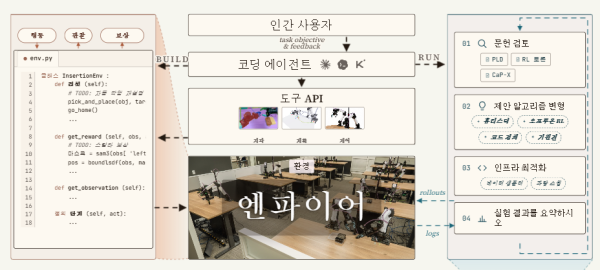
Nvidia unveiled ENPIRE, a framework that uses AI coding agents to train real robots without human involvement.
On June 17, blockchain media outlet Decrypt reported that Nvidia published the system in a paper with Carnegie Mellon University and UC Berkeley.
ENPIRE operates in two stages. First, a person intervenes once to create a reset routine that returns the workspace to its initial state and a reward function that judges success based on camera footage. After that, the agent searches research papers, selects ideas, chooses an appropriate learning method from imitation learning, reinforcement learning and rule-based approaches, rewrites code and tests it on a robot. This repeated process does not require a person to watch or intervene.
The key is that the AI coding agent directly runs the entire robot learning process. Agents such as OpenAI's Codex, Anthropic's Claude Code and Moonshot's Kimi Code have already performed automated loops of writing, testing and rewriting code. But such work has mainly been limited to what happens on a screen.
Nvidia operated eight dual-arm robots at its lab, the GEAR Lab. Each station had its own hardware, computer and coding agent, and shared learning results via Git. When one robot finds a better method, the result spreads to the entire equipment set within minutes.
In experiments, the robots successfully performed tasks such as inserting a pin into a 4 mm hole, installing a graphics card and cutting cable ties, and recorded a 99 percent success rate across four real-world environment tasks. In the pin insertion task, they showed higher accuracy than a method in which a person performs the work directly.
Training sped up as the number of robots increased. Nvidia said that when it scaled from 1 robot to 8, the time to master the Push-T task fell to about 2 hours from about 5 hours, and pin insertion was cut to about 40 minutes from more than 90 minutes. It said a limitation was that token-usage costs rose faster than the time savings.
Jim Fan (짐 팬), Nvidia's head of AI research and co-lead of the GEAR Lab, described the project as an attempt to make automated research possible in a physical environment for the first time. He said he handed the agent multiple robots, GPU resources and a sufficient token budget, then had it solve tasks as quickly as possible and keep the robots running.
Simulation performance did not carry over 그대로 to the real world. All three coding agents solved Push-T in the simulator, but when moved to real robots, 2 of the 3 failed. This was analyzed as being because variables in the given environment differed from the simulator.
Nvidia also tested ENPIRE on RoboCasa, a simulation benchmark. In the benchmark, which assumes a kitchen environment, the model showed higher performance than Nvidia's end-to-end model GR00T and the tool-using agent CaP-X, which omits the automated research process.
The unveiling extends Nvidia's Eureka, introduced in 2023. While Eureka was at the level of a language model writing a reward function for robots in a simulator, ENPIRE expanded a self-improving iterative structure to real hardware. Rather than only creating reward functions, the agent also handles experiment design, code modification and verification.
Competition in robot AI is also accelerating. Alibaba unveiled the Qwen-Robot Suite the same week, consisting of three foundation models for robot mobility, manipulation and physical simulation. While Alibaba promoted a software brain for robots it does not manufacture, Nvidia focused on automating the entire research loop on hardware it owns. Both approaches showed a shift in which real robots are emerging as the next arena for AI coding agent competition.
Today, we enable AutoResearch in the physical world for the first time! Introducing ENPIRE: we give 8 Codex agents a fleet of robots, an allocation of GPUs, and generous token budget. We set them free with a simple goal: solve the task as quickly as possible, keep the robots busy… pic.twitter.com/zC0OQNzDBs
 Yoonseo Lee
yslee@d-today.co.kr
Yoonseo Lee
yslee@d-today.co.kr