
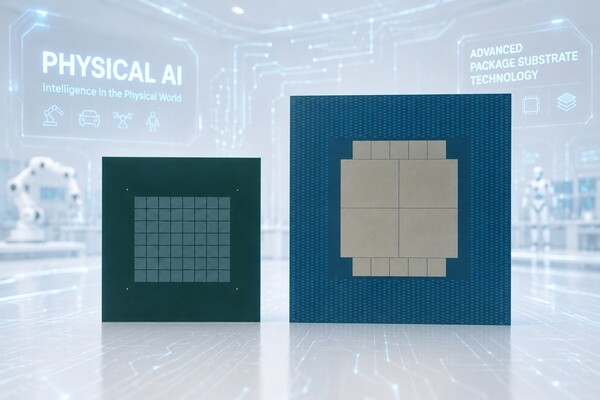
As inference AI spreads and reshapes demand in the semiconductor substrate market, LG Innotek is expanding its business focus beyond mobile into AI servers and data centres.
LG Innotek on June 16 held its “Package Solution Media Tech Day” at its headquarters in Magok, Seoul, and unveiled its mid- to long-term growth strategy for its semiconductor substrate business. It plans to step up its push into the AI server and data centre market, highlighting technological competitiveness in three high value-added substrates: FC-CSP (flip-chip chip scale package), FC-BGA (flip-chip ball grid array) and RF-SiP (radio frequency system-in-package).
A market previously led by training AI centred on GPUs is being reorganised around inference and agentic AI. Dependence on GPUs was high during the AI training stage. The market structure has changed as the role of processing and inferring trained data in real time has grown.
It said installation of GDDR (graphics double data rate) memory in AI accelerators and servers has been rising quickly, and FC-CSP substrates have started to be adopted for GDDR packaging. FC-CSP substrates connect semiconductor chips by flipping and attaching them through bumps, or microscopic metal protrusions. They were previously used mainly for smartphone APs (application processors) and LPDDR memory. The company cited superior electrical characteristics and higher integration than existing memory substrates as a reason behind the demand shift, saying that helps improve chip performance. Myung Se-ho (명세호), executive director in charge of package solution development at LG Innotek, said it has become a trend to replace existing memory substrates with FC-CSP substrates to enhance performance and integration.
LG Innotek has maintained a global top market share in FC-CSP substrates based on its mobile AP customers. Its top two customers account for 42 percent and 19 percent of sales, respectively, leaving it highly dependent on mobile APs. With AI-focused GDDR memory substrates added as a new revenue source on top of that customer base, it is diversifying its portfolio.
The company said profitability is improving visibly as memory product development enters its third to fourth year. It also said it has built a product roadmap for additional applications to various memory types such as SSDs even after GDDR7, leaving room for expansion.
It is also accelerating capacity investment to expand supply. Hwang Jung-ho (황정호), executive director in charge of package solution marketing, said the semiconductor production line in Gumi is operating at full capacity as new orders for memory FC-CSP substrates keep coming in. He said the company will first expand production lines for FC-CSP and RF-SiP substrates at a new semiconductor substrate plant in Vietnam, with construction starting this month, to meet demand from customers at home and abroad.
Investment in the new Vietnam plant totals 1 trillion won, and it will be financed with funds from the local Vietnam unit, with no funds injected from the South Korean headquarters. LG Innotek plans to build both automated lines and dedicated verification “golden lines” at the Vietnam plant to stabilise mass production. The company added it is also reviewing additional capacity investment for FC-CSP and FC-BGA at its Gumi plant in South Korea.
Package solution business operating profit jumps 82 percent; 1 trillion won target for 2031
Overall performance of its package solution business is also growing quickly, centred on high value-added products. Package solution sales last year rose 18 percent to 1.72 trillion won from 1.46 trillion won a year earlier, and operating profit jumped 82 percent to 128.9 billion won from 70.8 billion won. Operating profit in the first quarter also rose 31 percent from a year earlier. The business accounts for about 10 percent of the company's total sales, but contributes 19 percent of operating profit, playing a bigger role than its share in terms of profitability. Cho Ji-tae (조지태), executive vice president and head of the package solution business division, said the company will expand package solution sales to more than 3 trillion won by 2030 and foster it into a business with operating profit of about 1 trillion won in 2031, based on differentiated technological capability.
Along with FC-CSP, FC-BGA substrates are also directly linked to expanded investment in AI servers. According to Intel Market Research, the global FC-BGA substrate market is expected to grow at a compound annual rate of 10.6 percent, to $9.548 billion (about 14.46 trillion won) in 2032 from $5.42 billion (about 8.21 trillion won) last year.
LG Innotek has started mass production of FC-BGA for PC chipsets, and from the third quarter it will also begin mass production of products for PC CPUs in earnest. It also signalled a step-by-step entry by 2028 into high-end areas such as autonomous driving and CPUs and GPUs for AI accelerators and servers. Hwang said the share of CPUs and memory is expected to rise further in the era of inference AI, and new opportunities are opening even for latecomers as global big tech companies enter the CPU market in large numbers. He stressed that various global customers are visiting LG Innotek directly to discuss supplying FC-BGA substrates for CPUs.
 Dae-geon Seok
d2dg@d-today.co.kr
Dae-geon Seok
d2dg@d-today.co.kr