
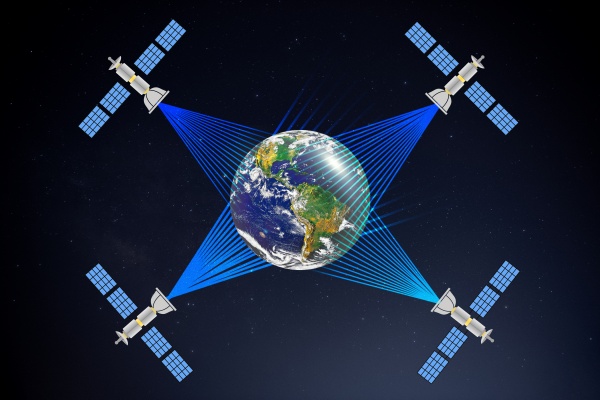
The U.S. Air Force is considering space-based solar power generation as a new way to supply electricity for remote military operations. The concept aims to cut the burden of fuel resupply and improve operational efficiency by using technology that wirelessly transmits power produced by satellites to the ground.
On June 15 local time, electric vehicle outlet CleanTechnica reported that the U.S. Defense Department is simultaneously pushing support for germanium, a key material for satellite solar cells, along with contracts with private companies and technology verification.
The Defense Department provided $18.1 million in support to a U.S. germanium producer in January. Germanium is a strategic resource used not only in high-efficiency solar cells but also in infrared optical equipment, night-vision goggles, surveillance equipment and weapon aiming devices. Its importance is growing, especially as it is used as an essential material for solar cells that supply power to military and civilian satellites.
The U.S. Air Force sees space-based solar power as an alternative that could address structural problems in military logistics. Expeditionary operations currently rely heavily on diesel generators, fuel transport vehicles and aerial resupply systems. Critics have pointed out that these methods generate huge logistics costs, increase the likelihood of detection by adversaries and burden pilots and maintenance personnel.
The space-based solar power system envisioned by the Air Force would collect solar energy in Earth orbit around the clock and then transmit it wirelessly to ground receivers. It is seen as advantageous because it is unaffected by weather and can reliably supply electricity to remote areas without a power grid.
In May, the U.S. Air Force signed a contract with U.S. energy company Overture Energy and began verifying ways to apply a space-based solar power system to large-scale remote military operations. Overture Energy is targeting a commercial service to transmit power from space to Earth within the next 10 years. The company is conducting power transmission tests using airborne platforms and plans to deploy related equipment in Earth orbit in 2028. It expects to supply megawatt-class power to the ground around 2030 and forecasts that in the early 2030s it will be able to transmit gigawatt-class clean energy anywhere on Earth 24 hours a day.
Related research is also active within the Air Force. Air Force education institution Air University is pursuing the PERSEUS project to address fuel resupply problems in the Indo-Pacific region. The project name is an acronym for Pacific Expeditionary Resilient Energy from Space for Unlimited Supply.
Researchers are not yet calling for immediate field deployment, but they have already demonstrated a scaled-down proof-of-concept model that wirelessly transmits power from a satellite to a mobile receiver. They assess the concept as having high military value because it must be able to supply power by following moving troops and equipment rather than fixed facilities.
The Air Force believes space-based solar power could become a key technology to reduce logistics burdens and support distributed operations. In a related report, it said: "Space-based solar power is a future capability that can reduce logistics burdens, support distributed operations and increase the operational speed of the Air Force and joint forces."
The United States is also accelerating supply chain restructuring alongside technology development. U.S. defense contractor York Space Systems announced on June 4 that it would acquire space solar power startup Solestial. The company said the acquisition was meaningful in shifting a space solar power supply chain that is highly dependent on China to a U.S.-based production system.
Solestial has received support from the U.S. Air Force and the U.S. National Aeronautics and Space Administration. It has been preparing since last year for mass production of next-generation solar cells. Early this year it also acquired specialized manufacturing equipment from bankrupt European solar company Meyer Burger. Solestial recently established a process that can produce in-house from wafers to solar cell cells, and it is pushing plans to integrate its supply chain by moving some German production facilities to the United States.
Some caution also exists about the short-term commercialisation prospects for space-based solar power technology. The industry sees its main uses at the current stage as focusing more on satellite power supplies and remote power transmission technology for military use than on terrestrial power grids. As a result, the U.S. strategy for space-based solar power is expected for the time being to focus more on securing satellite power sources and verifying power transmission technology for military logistics than on large-scale commercial power supply.
 Jinju Hong
hongjj@d-today.co.kr
Jinju Hong
hongjj@d-today.co.kr