
South Korea is accelerating the buildout of a national-level data infrastructure that will determine competitiveness in marine batteries. Korea Electronics Technology Institute (KETI) said on Tuesday it held a kickoff meeting for a project to develop a marine battery data hub platform. The Ministry of Oceans and Fisheries is 추진ing the project, and the Korea Institute of Marine Science & Technology Promotion (KIMST) is supporting it.
Battery use is increasing across marine mobility, including government vessels, navigation aids and underwater observation equipment, alongside the commercialisation of electric-propulsion ships. Marine batteries, however, are exposed to unstable conditions such as salinity, vibration and temperature changes. Safety evaluation standards, the accumulation of operational data, and systems for condition analysis and diagnosis remain insufficient. Internationally, data-based safety verification and life-cycle management systems are being strengthened, but South Korea has not secured a foundation to respond.
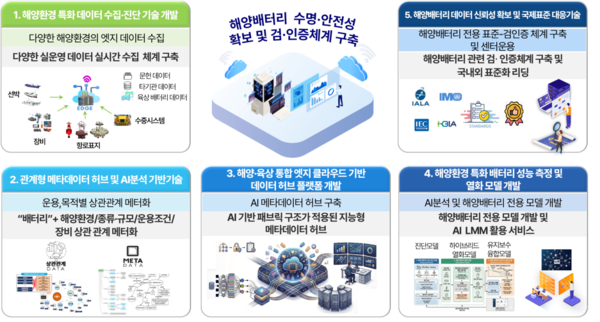
The project aims to develop end-to-end integrated technology, from data collection tailored to the marine environment to analysis, verification and linkage to standards. South Jeolla Province and Yeosu City are providing joint support, and 25 billion won is set to be invested over five years from 2026 to 2030. Key areas include data collection and diagnostic technologies tailored to the marine environment; a relational metadata hub and AI-based analysis technologies; development of an integrated marine and land edge-cloud data hub platform; development of battery performance measurement and degradation models; and technologies to respond to international standards.
KETI will lead and oversee the research and development. The Korea Maritime Transportation Safety Authority (KOMSA) will handle ship demonstrations, and the Korea Aids to Navigation Technology Institute (KATON) will handle demonstrations for aids to navigation. The Korea Testing Laboratory (KTL) will build a verification and certification system, and the Korea Science and Technology Policy Platform Cooperative (KSPP) will be responsible for policy linkage. A total of 13 organisations are participating in the consortium.
Once the research and development is completed, a real-time continuous monitoring system for marine batteries will be established. A marine-battery-specific degradation model and domestic and overseas verification and certification foundations will also be secured. Standardisation using public demonstration data and the provision of a public API are expected to increase private-sector usability and help cut costs spent on duplicated demonstrations and individual verification.
Kwon Ki-won (권기원), head of KETI's Marine and Fisheries ICT Business Group, said, "Based on the core full life-cycle technologies for land-based batteries where our country holds a competitive edge, securing demonstration data in the marine sector, which is expected to emerge as a future market, and proactively responding to global standards are expected to serve as an opportunity to lead the shared growth of batteries and related demand companies."
 Suk Dae-geon
d2dg@d-today.co.kr
Suk Dae-geon
d2dg@d-today.co.kr