
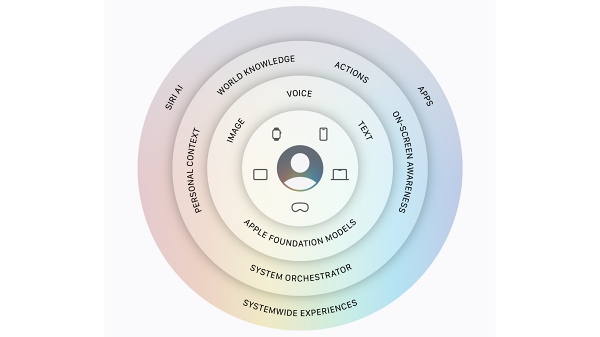
[DigitalToday reporter Yoonseo Lee (이윤서)] An assessment said Siri AI unveiled by Apple at WWDC 2026 focuses on understanding personal context spread across iPhone, iPad and Mac and immediately linking it to tasks.
TechRadar, an IT media outlet, reported on June 9 local time that Apple demonstrated new Siri AI features in the iOS 27 developer beta, the iPadOS 27 developer beta and the macOS Goldengate developer beta.
At the core is a method in which Siri directly finds information on the device. When asked about a podcast recently recommended by an acquaintance, Siri found a mention of a Sherlock Holmes podcast in messages. When asked to play it, Siri launched the Podcasts app. The explanation was that Siri AI’s strength lies in understanding intent based on data on the user’s phone and computer.
Interfaces also differed by platform. On the iPad, users can swipe down from the top of the screen to bring up a small Siri AI window in addition to voice activation. On the iPhone 17 Pro Max, a long press on the power button launched a new floating-style interface. Siri started filling in answers before the question ended and carried context more naturally than before. It also was hardly seen suggesting web search or using ChatGPT first.
On the Mac, Siri AI expanded Spotlight’s role. It can still be used to launch apps, but the new interface put a “search or ask” function front and centre. Complex questions were linked to Siri and Apple’s knowledge engine. Users could keep the Siri window open and continue other desktop tasks even after starting a search.
Cross-app integration was also central to the demo. It included selecting text in Notes and having Siri draft an email based on it, or turning long, unorganised email content into a camping gear list in Notes. It was structured so Siri bridges tasks that users previously handled by copying and organising content while moving between apps.
This flow, however, is implemented first around Apple’s own apps. In Apple default apps such as Messages, Mail, Notes, Podcasts and Camera, personal context and task execution connected relatively naturally. External apps such as WhatsApp and Gmail will require developers to separately build Siri AI integration features in the future.
Siri AI was also added to the Camera app. Users can now run Siri from a menu next to “Photo” and have it recognise what they are looking at to explain it or select it. It was also confirmed that the Camera app captures the scene during the analysis process. During the demo, Siri presented results by grasping intent without making separate corrections even when the user’s words were entered incorrectly.
The way Siri answers also changed. Siri showed sources for each answer, and conversation history was organised into card-style summaries. The new voice was more expressive than before, but in some scenes it still appeared to be in a refining stage.
The demo shows the direction of an “Apple-style AI assistant”. Siri AI is not simply a tool that answers questions. It is closer to a system that links the user’s messages, mail, notes, camera and Mac search environment to lead to real actions. Maintaining the same context across iPhone, iPad and Mac was presented as a competitive strength.
Siri AI is currently in beta and is provided through a waiting list system. The scope of external app integration, actual response accuracy and the way personal information is handled are expected to be key variables for future assessment.
 Yoonseo Lee (이윤서)
yslee@d-today.co.kr
Yoonseo Lee (이윤서)
yslee@d-today.co.kr