
SK Telecom said on Monday it will develop next-generation quantum cryptography technology through a Horizon Europe project, a large European Union (EU) research fund programme.
The project is a multinational collaboration with three European countries and will run for the next three years. Horizon Europe is the EU's flagship research fund programme. It has a total budget of about 95.5 billion euros, worth about 170 trillion won. South Korea joined in July 2025 as an associate member, the first Asian country to do so, enabling it to receive budget support directly from Europe.
SKT will receive Horizon Europe research funding for the first time for a private-sector company in Asia, based on its expertise in quantum cryptography. The goal is to implement and demonstrate a next-generation quantum key distribution (QKD) system based on "QPIC-AI (Quantum Photonic Integrated Circuit-AI)" to strengthen communications security.
QKD is a technology that generates and distributes encryption keys simultaneously at both ends of a communication link based on the properties of quantum mechanics. If a third party tries to intercept the signal, the quantum physical state changes, allowing hacking attempts to be detected.
Still, current QKD systems have limits to wider adoption, SKT said. Precision optical components such as single-photon light sources and interferometers must be assembled and aligned as separate devices, making systems large and heavy. Deployment costs are also high.
SKT aims to overcome these limitations through QPIC-AI. It will integrate optical components that previously required multiple devices into a single small chip using photonic integrated circuit (PIC)-based semiconductor process technology, shrinking the system. It will also embed artificial intelligence (AI) to detect and correct in real time optical states disrupted by changes in external conditions such as temperature and vibration. The aim is to improve QKD system stability.
QPIC process technology is expected to reduce unit costs through mass production and cut power consumption, as well as enable chip-based miniaturisation. SKT expects this will allow QKD technology, which has mainly been used in areas such as defence and finance, to spread to a wider range of fields.
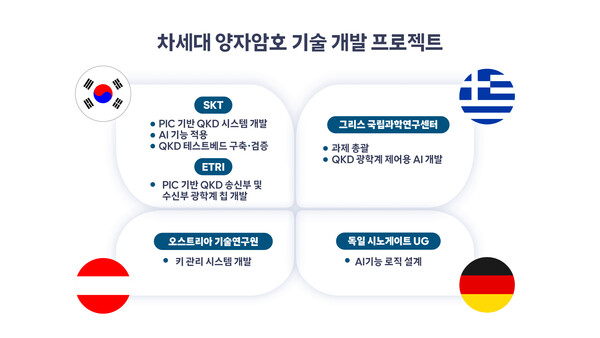
The project also includes institutions in three European countries, including Greece's National Centre for Scientific Research Demokritos (NCSRD), the Austrian Institute of Technology (AIT) and German semiconductor startup CinoGate UG. SKT will be responsible for developing the PIC-based QKD system, applying AI functions, and building and validating a QKD testbed. The Electronics and Telecommunications Research Institute (ETRI) will develop optical chips for PIC-based QKD transmitters and receivers.
The joint research with European countries is expected to contribute to international standardisation. South Korea and Europe have different certification standards for quantum cryptography technology, and the study plans to write a report analysing differences between countries. This is expected to lay the groundwork needed to integrate certification standards for international standard-setting bodies in the future.
SKT has pushed quantum cryptography technology development and commercialisation for more than 15 years since 2011, the first major company in South Korea to do so. Through winning and participating in projects by the Ministry of Science and ICT and the Defense Acquisition Program Administration, it has expanded wired QKD technology to wireless and satellite QKD technology and is also developing next-generation quantum cryptography technologies such as a high-performance 10 Gbps-class quantum random number generator (QRNG).
It is also seeking to expand in the defence and public-sector markets through products that add post-quantum cryptography (PQC) technology compliant with U.S. standards to zero-trust solutions and a quantum cryptography one-chip (Q-HSM).
Ryu Tak-ki (류탁기), head of network technology at SKT, said winning the Horizon project was an opportunity that confirmed SKT's quantum cryptography research and development capabilities. He said SKT will strengthen its leading position in the global quantum cryptography communications market by developing a next-generation QKD system that combines PIC technology and AI technology.
 Jin-ho Lee
jhlee26@d-today.co.kr
Jin-ho Lee
jhlee26@d-today.co.kr