
[DigitalToday reporter Seulgi Son (손슬기)] A survey showed 38.9% of South Koreans have experience using generative artificial intelligence such as ChatGPT.
The Broadcasting Media and Communications Committee and the Korea Information Society Development Institute (KISDI) on Wednesday released the results of the 2025 Intelligent Information Society User Panel Survey.
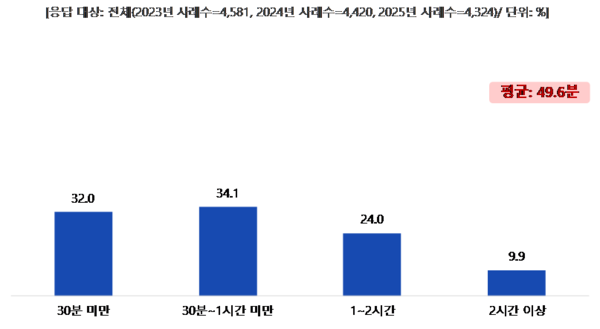
The experience rate rose for three consecutive years, from 12.3% in 2023 and 24.0% in 2024 to 38.9% this year. Average daily use among those who have used generative AI was 49.6 minutes. Some 68% of all users said they use it for at least 30 minutes a day.
The top reason for using it was that it is efficient for information searches, at 86.0%. It was followed by helping with time management at 72.6%, being useful for supporting learning activities at 68.2%, and helping solve complex problems and supporting routine tasks at 64.8% each.
Concerns about adverse effects also rose overall. The biggest year-on-year increase in concern was the spread of false information, up 9.6 percentage points. Misuse for crime rose 9.0 points, followed by generating content that is difficult to distinguish as true or false, up 8.9 points. Concerns also rose across a range of other adverse effects, including replacing work, reduced creativity, copyright infringement, and generating biased or discriminatory content.
The most common reason for not using generative AI was not knowing how to use it or finding it difficult to learn, at 63.5%. It was followed by service costs being burdensome at 59.2%, difficulty choosing a suitable service at 59.1%, and concerns about personal information and privacy violations and ethical issues at 59.0% each.
On AI recommendation services, the most common positive view was that they provide content reflecting personal interests, with 80.3% for informational content and 84.4% for entertainment content. Negative responses that they lead users to spend longer than planned were also high, at 75.4% for informational content and 75.8% for entertainment content.
On demands for service providers, the top request for generative AI providers was the need to establish internal checks and reporting procedures to prevent outputs that infringe on others' personal rights, at 81.3%. For AI recommendation service providers, the most common response was the need to disclose algorithmic criteria for selecting content, at 79.3%. Responses that government intervention is needed when it runs counter to the public interest were also high for both generative AI services at 75.4% and AI recommendation services at 74.9%.
The survey has been conducted annually since 2018 under the Framework Act on Intelligent Informatization. It covered 4,324 people nationwide aged 18 to 72 who use smartphones and the internet in their daily lives. Detailed results can be downloaded from the Broadcasting Media and Communications Committee website, the Statistics Korea website, and the Korea Information Society Development Institute's policy website for users of AI services.
 Seulgi Son (손슬기)
sageson@d-today.co.kr
Seulgi Son (손슬기)
sageson@d-today.co.kr