
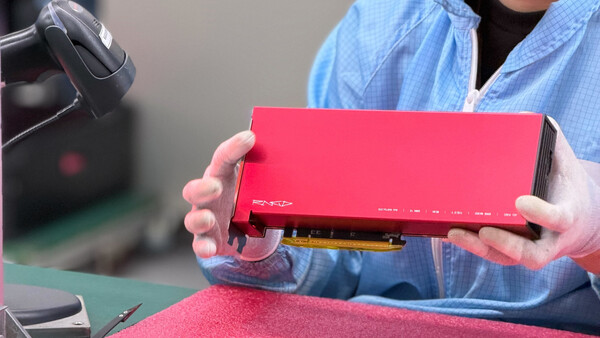
The Budget Office said on Tuesday that Budget Director Yong-beom Cho (조용범) visited AI chip startup FuriosaAI’s headquarters in Seoul’s Gangnam district and held a meeting on the direction of fiscal investment in the AI semiconductor industry.
Attendees included Cho, Tae-wan Park (박태완), director general for information and communications industry policy at the Ministry of Science and ICT, the heads of five AI semiconductor companies including FuriosaAI, Rebellions, HyperAccel, DeepX and Mobilint, and finance experts including Shinhan Financial Group and LB Investment.
The Budget Office is running a “field listening project” to visit more than 100 sites to reflect on-the-ground views in next year’s budget proposal.
Ahead of the meeting, Cho watched a demonstration of FuriosaAI’s next-generation products and checked the status of domestic neural processing unit (NPU) technology development. NPUs are semiconductors specialised for AI inference and are drawing attention as next-generation AI chips that could replace graphics processing units (GPUs) in terms of power efficiency.
Cho said that the next 1 to 2 years are a “golden time” to leap into the ranks of the world’s three leading AI powers. He said the government will use this year’s 9.9 trillion won AI budget to support GPU expansion and productivity gains through AI transformation, and will also actively support funding next year so an independent AI ecosystem can take root. He also stressed that as high-efficiency, low-power domestic NPUs emerge as an alternative to overcome the limitations of GPUs, the government will underpin the creation of an early market.
The Budget Office plans to reflect views from the meeting in drawing up the 2027 budget plan and the national fiscal management plan.
 Seul-gi Son (손슬기)
sageson@d-today.co.kr
Seul-gi Son (손슬기)
sageson@d-today.co.kr