
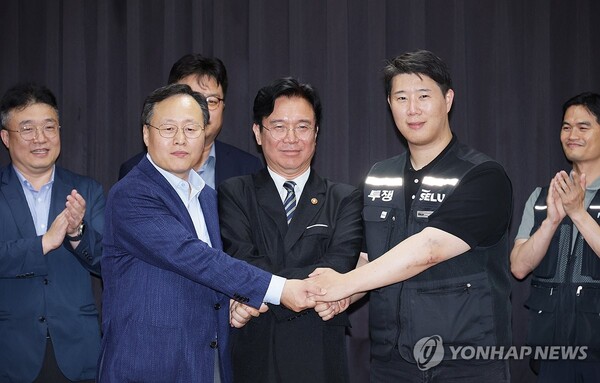
A tentative 2026 wage agreement between Samsung Electronics and its labour union cleared a ballot of union members on May 27. It was approved with 73.7 percent in favour and 95.5 percent turnout, effectively easing fears of a general strike. The company and the union completed all negotiating procedures 167 days after their first meeting in December last year.
The joint bargaining body said 62,616 of 65,593 eligible members took part, and 46,142 voted in favour. The joint bargaining body held a signing ceremony with management at 11 a.m. on Tuesday.
A total of 16,474 voted against. Differences among unions were clear. The inter-company union accepted the agreement with an 80.6 percent approval rate, while the National Samsung Electronics Labor Union, known as Jeonsamno, posted an approval rate of 21.1 percent. The figures reflected differences between the inter-company union, centred on the DS (semiconductor) division, and Jeonsamno, which has a higher share of members in the DX (finished products) division.
The key element of the agreement is the creation of a special management performance bonus for the DS division. Samsung Electronics also introduced an operating profit-linked "N percent performance pay" system, following SK Hynix. Funding for the special management performance bonus will be 10.5 percent of business performance, allocated 40 percent to the division and 60 percent to business units. The common-organisation payout rate is set at 70 percent of the memory business unit's level, and loss-making business units will receive 60 percent of the common payout rate, starting with the 2027 payout.
The bonus will be paid entirely in the company's shares. One-third of the shares paid can be sold immediately, while the remaining shares are restricted from sale in equal one-third portions for 1 year and 2 years, respectively. Assuming an estimated annual operating profit of 340 trillion won for this year, the per-person special bonus in the DS division is estimated at about 630 million won for the memory business unit and about 180 million won for the System LSI and foundry business units.
By contrast, employees in the DX division will only receive a special bonus worth 6 million won in addition to existing OPI, widening the gap with the memory business unit to more than 100-fold. Jeonsamno's 21.1 percent approval rate, effectively signalling opposition, is due to such imbalance in compensation between divisions. The Samsung Electronics Labor Union Donghaeng, centred on DX division employees, filed an injunction request with the Suwon District Court the previous day to halt the voting procedure.
While strike risk has eased, follow-up conflict remains. The Donghaeng union plans to file an additional injunction request to suspend the effect of the tentative agreement itself. The union argues that the inter-company union violated its duty of fair representation by excluding their voting rights.
Shareholder backlash also remains. A shareholder group is signalling a lawsuit, arguing that prioritising performance bonuses from operating profit before taxes and dividend payments infringes shareholder interests. It also raises a procedural issue, saying bonuses should be paid after a shareholders meeting.
 Suk Dae-geon
d2dg@d-today.co.kr
Suk Dae-geon
d2dg@d-today.co.kr