
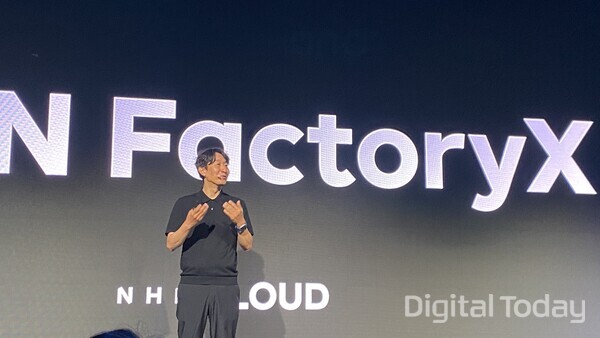
[DigitalToday reporter Seulgi Son] NHN Cloud has launched FactoryX, an artificial intelligence (AI) full-stack brand covering infrastructure, platforms and services. It also set a goal of raising the share of AI in total revenue to 50 percent by 2027.
Kim Dong-hoon (김동훈), CEO of NHN Cloud, said at a press briefing held on May 26 at The Plaza Hotel in Jung-gu, Seoul, that the AI race for supremacy has shifted from large models to business execution environments. He said the company will roll out full-stack services that provide stable operation and cost optimisation based on seven years of experience building and operating GPU infrastructure.
FactoryX consists of three layers: infrastructure, platform and service. It offers an integrated package from GPU procurement to operational optimisation and agent execution.
NHN Cloud said the global AI infrastructure market is expected to grow to $939.4 billion by 2030. It said annual average growth of more than 20 percent is expected. It also said 2.5 trillion won will be invested in AI infrastructure in South Korea this year alone.
The infrastructure layer focuses on real corporate use, centred on an exascale AI cluster. The recently opened FactoryX Seoul data centre has been built with 7,656 Nvidia Blackwell (B200) chips. A total scale of 27.4 exaflops (EF) and single-GPU clustering of 4,080 chips are key. Kang Min-soo (강민수), NHN Cloud's chief infrastructure officer (CIO), said securing GPU servers alone takes more than 26 weeks, and InfiniBand switches and cables take more than 48 weeks. He said the total project period is at least more than 52 weeks when the installation period is included. Nearly 100 percent of the GPU resources currently built are in operation.
The company also sought to differentiate itself in cooling design. GPU heat generation is increasing with each generation, with H100 at 700 watts, B200 at 1,200 watts and Rubin (R100) approaching 1,500 watts. NHN Cloud applied a 100 percent liquid-cooling system that controls a high-density environment of 75 kilowatts per rack. The company said the annual GPU failure rate fell to one-third of the level seen with air cooling. It said mean time between failures rose to 480,000 hours from 180,000 hours. The share of AI servers using liquid cooling is expected to jump to 57 percent this year from 23 percent in 2025.
In the platform layer, the company provides GPU Live, a self-developed integrated GPU management platform. It aims to eliminate resource and cost waste from idle GPUs. It automatically separates training and inference workloads and dynamically allocates resources. When large-scale distributed training is needed, it occupies a large cluster, and for lightweight inference it divides resources into smaller units to create serving endpoints. It also supports priority management based on organisational policies and real-time integrated monitoring. With GPU Live applied, cold-start latency is cut by up to 61 times to 1.2 seconds from 75 seconds. GPU utilisation improves by an average of more than two times.
Kim Tae-hyung (김태형), chief technology officer (CTO), said when 1 H100 chip is idle, $2.1 per hour is wasted. He said if a 1,000-chip cluster is used at only 50 percent, about $9.2 million a year, or about 14 billion won, is effectively lost. He added that training is long while inference is short and frequent, making workload characteristics completely different, but the current architecture is optimised for training.
The company is also preparing for rising inference demand. Kim said services were provided to match overwhelming training demand, and next year, when next-generation models ramp up, will be the time the NPU market expands. NHN Cloud is currently operating a domestic NPU-based service at a scale of 11 petaflops (PF) at the Gwangju National AI Data Center.
Project X, a service-layer product, is scheduled to launch in the second half of this year. It is a solution that lets companies design customised AI agents based on natural language. Ahn Seong-min (안성민), CEO of NHN Enterprise, said it provides a cloud environment where AI agents can make decisions on their own, call tools and complete tasks without people. He said the structure solves three problems at the same time: security, corporate workloads and cost. It will be offered in two formats, private and public. The private option is built to fit a corporate environment, while the public option lets startups and individuals use commercial and open models in a standard environment.
◆Target of 50 percent AI revenue by 2027..."Leap to a national representative AI infrastructure company"
NHN Cloud aims to raise the share of AI revenue to about 38 percent in 2026 and 50 percent in 2027 from 13 percent in 2025. It targets annual total revenue growth of more than 24 percent, and more than 30 percent when expansion of its GPU business is factored in. The company said it expects to swing to an annual profit by the end of this year.
It did not participate in this year's government GPU build-out project, but is preparing a new data centre targeting the project the year after next. Kim said last year's project is now in full operation this year and the company focused on operations. He said resources currently secured are larger than this year's new build-out volume, and the 4,080-chip single-cluster service will remain the largest in South Korea through next year.
The win rate for new public-sector projects remains above 60 percent. Kim said the current AI market is structured with the government leading and private companies using infrastructure. He said market opportunities differ depending on who can provide stable services quickly and boost efficiency. He said an independent infrastructure ecosystem is essential for South Korean companies to conduct AI business while protecting data sovereignty, and stressed the company will become a national representative AI infrastructure company leading South Korea's leap into an AI G3 powerhouse at the forefront.
 Seulgi Son
sageson@d-today.co.kr
Seulgi Son
sageson@d-today.co.kr