
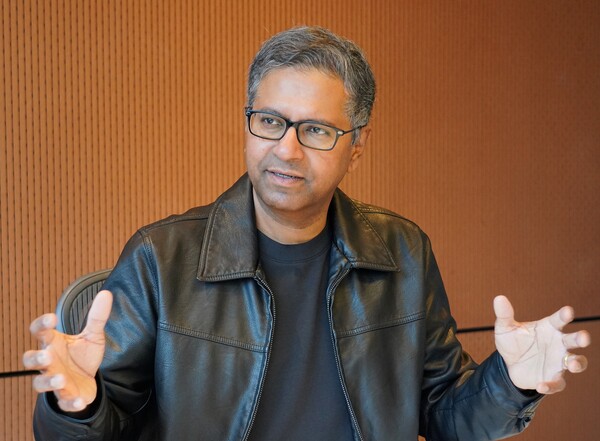
[DigitalToday reporter Chi-gyu Hwang] "The computing paradigm is shifting from a deterministic structure to one centered on probability. This transition requires many changes across networks and security, and Cisco will lead it."
Vijoy Pandey (비조이 판데이), a senior vice president who leads Cisco's innovation incubator Outshift, highlighted shifts in computing and network paradigms driven by the rise of AI and quantum computing. He made clear that Cisco aims to expand its share in next-generation infrastructure markets with the Internet of Cognition.
In an interview with reporters on the 9th, he said AI agents and quantum computing are both 'probabilistic engines' that operate based on probability, reasoning, inferring and making judgments instead of executing commands. He said this is a fundamental paradigm shift, not separate developments, and is changing how networks are designed, operated and trusted. He said Cisco would support these changes through the Internet of Cognition.
The following is a Q&A with Pandey on the changes AI and quantum computing will bring to the IT infrastructure market and Cisco's strategy.
-What does AI mean from the perspective of changes in computing infrastructure?
"Until now, computing infrastructure has been deterministic. If the input is the same, there has been a guarantee the output would be the same. But because of AI, the computing paradigm is shifting from deterministic to probabilistic. There is no guarantee the output will be 100 percent the same. Changes are also needed at the infrastructure level.
The existing internet consists of 4 pillars: discovery, which finds where traffic should go and connects it; identity; protocols; and telemetry and observability. The era of AI agents requires changes across all 4 pillars. Discovery, handled by DNS, needs to search based on agents' capabilities and relevance, and identity also needs access controls based not on roles but on what the AI agents do.
On protocols, there must be protocols for agents to communicate with each other. They must support not just simple connections between agents but also collaboration. In the case of observability, it must go beyond observation to determine whether AI agents are operating properly as intended."
-Cisco is emphasizing the Internet of Cognition as an AI infrastructure strategy. Why should it be in focus now?
"AI models and agents are continuing to get smarter. Individual models and agents are getting smarter, but there is a problem that they are fragmented from each other. When agents collaborate as a team, results improve and performance rises. The Internet of Cognition is an open architecture layer for this. It consists of protocols that align shared intent among agents and a fabric that maintains collective memory across the system. This supports agents so they can reason together beyond organizational boundaries and create new value."
-Supporting the Internet of Cognition appears to require changes to current network structures as well.
"The OSI (Open Systems Interconnection) 7-layer network model is now behind the times. Layers 8 and 9 are needed so intelligence can be connected and reasoning can take place. Current networks cannot be understood without interpretation. The new layers must deeply understand what happens in networks as comprehensive state information, not as individual agents."
-At what stage is Internet of Cognition technology now? I am also curious about the roadmap going forward.
"The Internet of Cognition is not the distant future. Commercialisation is already under way. Cisco is building infrastructure across all 4 pillars of the internet. In discovery, it has been embedded in Webex, and Cisco also provides AI Canvas so infrastructure can be managed using AI agents. For identity, it supports AI agents through its authentication security solution Duo. It will also start showcasing products related to quantum. It will soon release quantum security and then disclose quantum networking technology."
-The concept of probabilistic computing is not free from errors. What is a way to address this?
"Even if a probabilistic computing paradigm arrives, it does not replace existing deterministic methods. It is only added. That makes it possible to combine the strengths of the two approaches in the right places. There are uses for which probabilistic computing is suitable. For example, tasks like climate forecasting are areas where probabilistic computing is more effective. Through its data analytics platform Splunk, Cisco also provides evaluation functions. It is similar to observability, but its feature is that it observes whether a model is working properly and improves the model based on feedback."
-It is hard to say quantum computing has been commercialised yet, but you stress that adopting post-quantum cryptography, or PQC, is urgent. Why?
"The current RSA cryptosystem can be decrypted when quantum computing is commercialised. The number of qubits needed for decryption is decreasing. There is even talk that decryption is possible with 10,000 qubits. Quantum computers with 1,000 qubits exist, and if you connect 10 of them, the story goes, you can build a quantum computer on the scale of 10,000 qubits. That is why there are forecasts that by 2029, existing cryptosystems can be decrypted with quantum computers.
Taking this into account, a new software structure is needed, and organisations must adopt PQC as part of that. Cisco is making many investments not only in a quantum security roadmap and key distribution using quantum mechanisms but also in building quantum networks. Quantum networks are completely different from existing ones. It is a new network model that must be built again from scratch."
-Various companies are moving quickly to provide AI-optimised IT infrastructure. What areas is Cisco focusing on and what is its differentiation strategy?
"Cisco's view is that to prepare for agentic AI and quantum computing, there is a need not only for scale-up that expands infrastructure vertically but also scale-out that grows it horizontally, and 'scale across' that connects scale-out-based data centres. Cisco is not simply a networking company but a distributed systems company. As such, it can demonstrate strengths in scale-out and scale-across environments."
-How do you think companies should approach the Internet of Cognition?
"It is important to create use cases that can actually be used. Cisco also announced 8 cases in which it connected multiple agents and enabled them to collaborate. Referring to these, it would be better to start with smaller things and test rather than aiming for one big hit. It is also good to directly participate in open-source projects related to AI agents."
-AI-powered attacks are becoming more sophisticated. How is Cisco responding?
"As hackers use AI, the competition between attack and defense will continue. Cisco supports companies so they can respond to threats by training not only on public data but also on data that companies hold themselves. Cisco is also participating in Anthropic's Glasswing project, which was introduced in a post related to Mythos, its next-generation model."
 Chi-gyu Hwang
delight@d-today.co.kr
Chi-gyu Hwang
delight@d-today.co.kr