
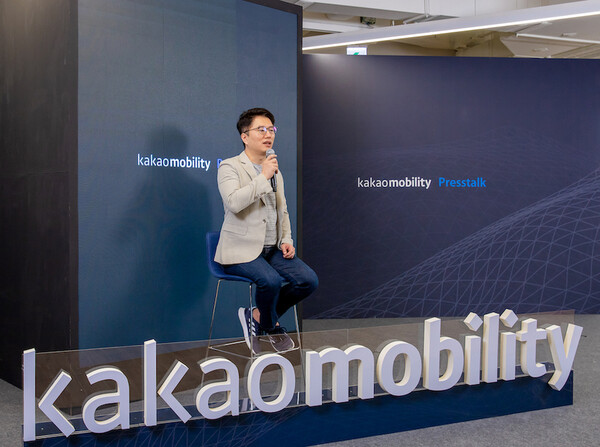
Kakao Mobility has formalised a shift to become a physical AI-based technology company. The company said on March 13 that chief executive Ryu Keung-sun (류긍선) presented a vision of “a leap to a physical AI-based future mobility company” in a letter sent to employees.
Ryu said, “We will be reborn as a technology company leading the physical AI era that takes responsibility for all movement in daily life.” He said the company would secure technology sovereignty, compete on equal terms with global players and lead the future mobility market.
Ryu stressed that the data and technology infrastructure accumulated through the digital transformation process across the mobility industry would be a core competitive edge in completing physical AI. He cited four assets unique to Kakao Mobility: a refinement system for mobility data for AI training, map data reflecting real-time road changes, capabilities to standardise operations from call to settlement, and hubs and operating infrastructure.
He also set out a direction to build a virtuous cycle between existing services and physical AI technology. Ryu said, “Physical AI technology will combine with existing services to raise operating efficiency and innovate service quality, creating a virtuous cycle.” He said he would build a strong mobility ecosystem in which technology and services are organically linked.
A strategy to internalise technology is also a core pillar of the future vision. Ryu said, “Autonomous driving capabilities built over the past about 5 years through broad partnerships and investment have now become our unique asset.” He stressed plans to internalise core physical AI technologies and build unique technological competitiveness spanning software to hardware control. He added, “We will keep open the possibility of cooperation, but we will not rely only on outside parties for core capabilities and leadership, and will secure unique technology sovereignty optimised for our environment.”
It will also push ahead with overhauling its execution framework. Kakao Mobility plans to strengthen a technology 추진 framework that connects “verification-operation-expansion” so that physical AI technology can be verified and spread in real service environments. It has also moved to reinforce leadership in global AI and autonomous driving and to overhaul its mid- to long-term technology roadmap.
Ryu said, “When strengthening the competitiveness of existing services and expanding into physical AI are achieved in harmony, our true next chapter will open,” and urged all employees to join.
 Dae-geon Seok
d2dg@d-today.co.kr
Dae-geon Seok
d2dg@d-today.co.kr