
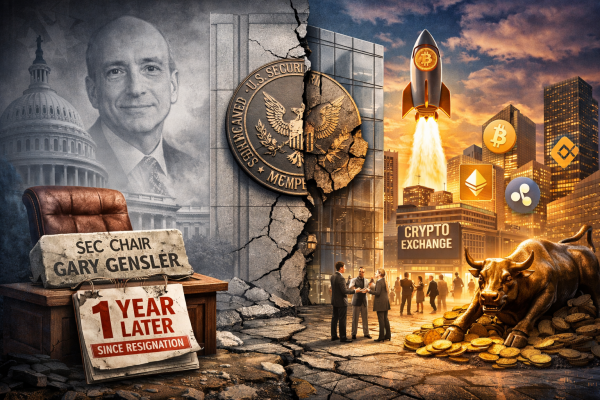
[Digital Today reporter Jinju Hong] One of the crypto pledges Donald Trump made as a presidential candidate was to dismiss the chair of the U.S. Securities and Exchange Commission (SEC) immediately upon taking office. In fact, former SEC chair Gary Gensler resigned shortly after Trump took office, a move seen as a turning point from the tough regulatory stance long criticised by the crypto industry.
On Jan. 19, local time, Cointelegraph reviewed how crypto policy has changed 1 year after Gensler stepped down.
During his tenure, Gensler pursued a tough, enforcement-driven policy that treated digital assets as securities, repeatedly clashing with the industry. That approach is also cited as a backdrop to political pushback by the industry, including Ripple Labs’ donation to a political action committee (PAC) supporting pro-crypto candidates in the 2024 U.S. election.
After Gensler resigned, Trump appointed Mark Uyeda, an SEC commissioner aligned with Republicans, as acting chair, and the SEC’s digital asset policy changed rapidly. Most multi-year investigations and enforcement actions already under way were withdrawn, and the commission’s leadership was reshaped with Republicans.
Less than a month after Uyeda took office, the SEC cancelled a civil lawsuit it had filed against Coinbase in 2023. It later halted investigations into Robinhood Crypto and Uniswap Labs, and enforcement action against Ripple that began in 2020 also moved toward withdrawal. These are seen as examples showing a fundamental shift in the SEC’s approach to crypto regulation.
The pace of lawsuit cancellations continued after Paul Atkins, whom Trump nominated, took office as SEC chair after Senate confirmation in April last year. Some lawmakers, however, raised questions, saying the Trump administration’s decisions were not unrelated to close interests in the crypto industry.
Trump and his family invested in a crypto company called World Liberty Financial and launched its own stablecoin. Trump has promoted the 'Official Trump' memecoin, and his sons have run a mining business called 'American Bitcoin'. As of June 2025, profits the Trump family has realised through crypto-related businesses are estimated to exceed $1 billion.
The SEC held a series of meetings in 2025 with industry, legal and policy experts to discuss digital asset custody, decentralised finance (DeFi), tokenisation and financial privacy, but policy direction became uncertain as debate on the Digital Asset Market Clarity (CLARITY) bill stalled in Congress. The bill passed the House of Representatives but has been delayed in the Senate, and further discussions were postponed due to opposition from Coinbase CEO Brian Armstrong.
Meanwhile, after leaving public office, Gensler returned to the MIT Sloan School of Management as a professor and continues to speak publicly, still describing cryptocurrencies as "speculative assets". The SEC’s abrupt policy shift since his departure is seen as an example of how sensitive the U.S. crypto regulatory environment is to political change.
 Jinju Hong
hongjj@d-today.co.kr
Jinju Hong
hongjj@d-today.co.kr