
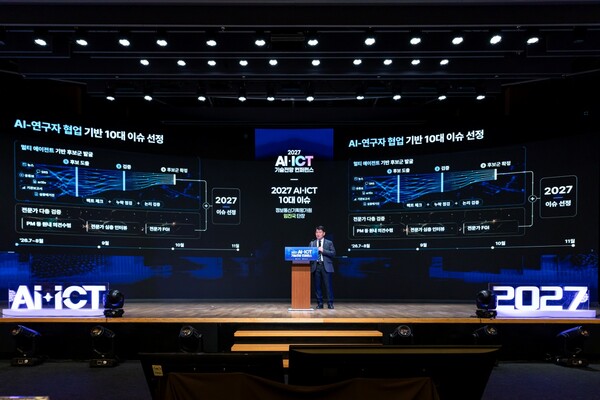
Productivity gains through AI transformation (AX) were presented as the biggest theme for the AI and ICT industry in 2027. How efficiently AI can handle real work and cut costs is expected to determine industrial competitiveness.
The Ministry of Science and ICT and the Institute for Information & Communications Technology Planning & Evaluation (IITP) held the "2027 AI and ICT R&D Technology Outlook Conference" at the Korea Chamber of Commerce and Industry in Seoul on Tuesday. They announced next year’s top 10 AI and ICT issues and directions for research and development investment.
Jin-guk Lim (임진국), head of IITP’s Digital Future Policy Division, named "realising AX productivity" as the biggest theme for 2027. He presented 10 supporting issues: Agentic Economy, the spread of physical AI, competition in artificial general intelligence (AGI), AI semiconductor optimisation, a dual race in speed and performance for AI data centres, maximising token efficiency, the evolution of spatial computing, AI-native 6G, Cyber Shield Dome and full-stack sovereign AI.
◆Agents carry work through to completion... physical AI and AGI competition accelerates
The first issue, the "Agentic Economy", refers to a shift in the economic structure in which AI agents carry out work across the board in place of people. It is expected to advance beyond simply answering questions or assisting tasks toward completing work end to end.
Lim said trust is essential for wider use of AI agents. He said a "Know Your Agent" system to verify an agent’s identity and delegated authority is needed to establish standards for responsibility and costs in task execution.
In physical AI, he said competition to generalise systems that complete real missions will gather pace. Key elements were cited as self-directed integrated action intelligence, in which robots perceive their surroundings and decide and act on their own, and dedicated on-device computing technology. Competition to secure "physical AI-ready data" that uses real-world data for AI training is expected to intensify.
In AGI, recursive self-improvement (RSI) technology, in which AI improves its own performance, was presented as a variable. The analysis said the pace of technological development could accelerate as AI develops and improves new AI. It said there is a possibility that an "AI autonomous scientist" could emerge to help solve complex problems such as overcoming disease, food crises and climate disasters.
◆AI semiconductors and AIDC performance race... maximising token productivity
In AI infrastructure, improving inference performance and cutting costs are expected to emerge as core competitive factors. AI semiconductors are expected to move beyond raising the computing performance of a single chip to heterogeneous computing that combines different types of semiconductors, along with joint optimisation of software and hardware.
For domestic neural processing units (NPUs), it was seen as becoming important to raise power efficiency and inference performance through an open full-stack strategy that optimises AI models, inference engines, compilers and semiconductors in an integrated way.
In the AI data centre (AIDC) market, a dual competition over build speed and operating performance is set to begin in earnest. Tasks include bringing forward start-up timing by using modular data centres and boosting token productivity per unit of power by integrated control of power and cooling systems.
Telecommunications infrastructure linking the inside and outside of data centres was also cited as a key competitive factor. The importance of scale-up to expand compute resources within a server, scale-out to expand connections between servers and scale-across technology to connect compute resources between data centres is expected to grow.
Token efficiency, which is directly tied to AI service operating costs, was also selected as a major issue. Competition is expected to shift beyond simply lowering the price per token to reducing "task cost", the cost required to complete a single job.
Lim also mentioned cases in which costs were cut by about 60 percent by controlling token usage. "Competition to optimise and improve the economics of AI services will accelerate," Lim said. "We should also pay attention to improving operational efficiency using open-weight models," he said.
◆Spread of spatial computing and AI-native 6G... security and AI sovereignty remain tasks
Spatial computing is expected to draw attention as a new interface for realising AX. It is expected to develop away from text-focused AI use toward recognising voice, gaze, gestures and surrounding environment information through smart glasses and providing AI services in real spaces.
Privacy protection issues arising from the spread of spatial computing were cited as a problem that must be addressed. The explanation said technical controls on devices themselves and related legal systems need to be put in place because smart glasses can identify individuals’ daily patterns, preferences and even social relationships.
In next-generation communications, "AI-native 6G" was selected as a major issue. The outlook said 6G networks will develop beyond a simple means of data transmission into an execution infrastructure supporting AI inference and spatial awareness, and AI-based autonomous network operations will also expand.
The possibility that the scope of communications infrastructure could extend into space was also raised. The analysis said key areas in the next-generation infrastructure race will include low Earth orbit satellite communications and on-orbit AI chip computing technology for space data centres.
"Cyber Shield Dome", an AI-based autonomous multi-layer defence system, was also highlighted. Cyber Shield Dome refers to a system combining autonomous defence agents by organisation, threat intelligence sharing within industries and joint responses at the national level. The advice said a system is needed to verify and control AI safety from the design stage through execution and operation, as AI risks could expand beyond misuse or data bias to loss of system control.
The final issue, "full-stack sovereign AI", underscored a trend in which the scope of securing AI sovereignty is expanding beyond models, data and semiconductors to include networks, computing, security and power infrastructure. The outlook said capabilities to stably operate and control the broader AI infrastructure, beyond securing technologies in-house, will become important.
The government will expand AI and ICT R&D investment next year in response to these technological changes. While parliamentary review remains, the AI and ICT R&D budget is expected to exceed 2 trillion won for the first time. The government plans to focus investment on securing national core strategic technologies, including three mega-projects, and strengthening industrial competitiveness.
Ryu Je-myung (류제명), second vice minister at the Ministry of Science and ICT, said, "Now, as the landscape of global AI competition is being rapidly reshaped, is a prime opportunity to secure overwhelming national competitiveness in AI and ICT." He added, "We will accelerate securing national core strategic technologies and growth through technological innovation to connect AI and ICT R&D results to a better life for the people."
The conference runs through Thursday. On Wednesday, participants will discuss technology outlooks and investment directions in AI semiconductors, cybersecurity, quantum and next-generation communications. On Thursday, they will share plans for international joint research cooperation with the United States, the European Union and Singapore, and strategies to foster ICT talent.
 Jin-ho Lee
jhlee26@d-today.co.kr