
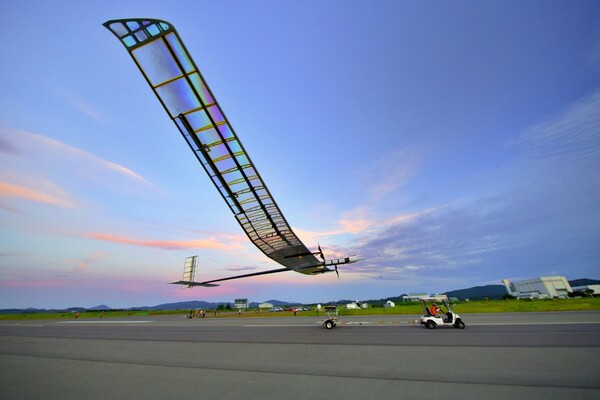
The Korea AeroSpace Administration is moving to develop a hybrid vertical take-off and landing aircraft after succeeding in a 170-hour continuous flight by a stratospheric solar unmanned aircraft. It plans to develop an aircraft that combines an engine and a battery and use it for logistics transport and emergency patient transfers.
The Korea AeroSpace Administration said on Tuesday it will press ahead in earnest with a project to develop a hybrid vertical take-off and landing aircraft to foster the future aviation industry, based on the long-duration flight results of the stratospheric solar unmanned aircraft EAV-4.
A stratospheric unmanned aircraft is an aircraft that can loiter for long periods at an altitude of about 20 km above the ground and monitor a wide area. It is relatively less affected by weather and can be used for disaster monitoring and observation. In island and mountainous areas with insufficient communications infrastructure, it can also serve as an aerial base station.
The Korea AeroSpace Administration succeeded in the EAV-4 flight test conducted in August with 170 hours and 5 minutes of continuous flight. That is more than three times the domestic record of 53 hours set by EAV-3 in 2020. The Korea AeroSpace Administration said the result ranks second in the world after European aircraft maker Airbus' Zephyr.
The flight test also demonstrated a mission to detect wildfires. Using electro-optical and infrared cameras, it captured ignition points within seconds and tracked and predicted the direction of smoke spread and the path of moving embers.
The Korea AeroSpace Administration plans, led by private companies, to push disaster monitoring and observation and communications relay using stratospheric unmanned aircraft, as well as verification of domestically made solar cells, by 2030. It aims to build an always-on stratospheric surveillance system based on independent technology.
It is also pushing a project to develop a hybrid vertical take-off and landing aircraft. A hybrid VTOL aircraft can take off and land without a runway and uses both a battery and an engine. It can carry more people and cargo and fly longer distances than an electric aircraft.
The Korea AeroSpace Administration will conduct research and development for five years from 2028 to 2032. It plans to verify technology step by step, from securing core technologies such as hybrid propulsion to developing the aircraft. The aircraft developed will be used for emergency logistics transport and emergency patient transfers in island and mountainous areas, and for air taxis between regions.
Oh Tae-seok (오태석), head of the Korea AeroSpace Administration, said, "Industry, academia and research institutions will join forces to secure the technology directly and work to ensure it leads to practical development of the aviation industry and greater public convenience."
 Jin-ho Lee
jhlee26@d-today.co.kr