
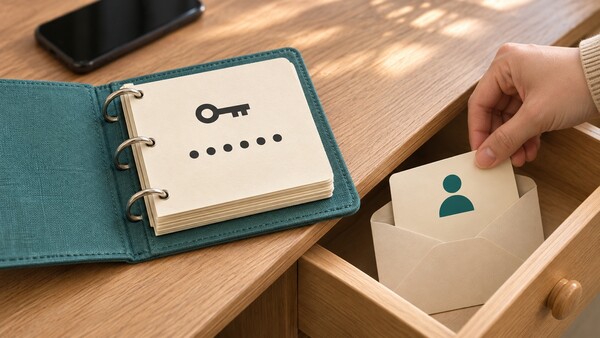
An analog method is drawing attention in Japan that involves writing passwords on paper while storing account IDs and email addresses separately. The approach is aimed at helping older people who are not familiar with smartphones organise account information easily while reducing the risk from losing a notebook.
On Tuesday, the Sankei Shimbun reported that Piccolo, a general goods shop in Tokyo’s Hongo area, produced a password-management notebook called “Passrakucho”.
The product uses small cards on which users write the service name and password and insert them into a binder. Users can replace only the relevant card when changing a password or cancelling a service, making it easier to organise information for multiple accounts.
A feature is the separation of account information. Users write the service name and password in the notebook, while keeping the email address and ID used for login on separate cards. The aim is to reduce the chance that information is leaked all at once if only one side is lost or exposed to someone else.
Makiko Imai (이마이 마키코) of Piccolo proposed “masked notation” that changes some characters into markings only the user can recognise, rather than writing the full password exactly as it is. Numbers can be remembered by linking them to a grandchild’s birthday, and letters by linking them to a pet’s name.
Such products also tie in with expanding smartphone use among older people. A January survey of 1,300 people aged 60 to 84 by NTT Docomo’s Mobile Society Research Institute found smartphone ownership was 95 percent among people in their 60s, 86 percent among those in their 70s, and 69 percent among those aged 80 to 84. As smartphones become widespread, the burden of remembering and managing passwords for multiple apps has also increased.
Paper records can also be used to organise digital legacies after death. Yusuke Furuta (후루타 유스케) of the “Association for Thinking About Digital Legacies” introduced a method of leaving passwords on paper so family members can unlock a smartphone when needed. It involves writing them on thick business-card-sized paper, covering it with multiple layers of correction tape, and scratching it off to check when necessary.
Still, masked notation and correction tape are not encryption technology. Birthdays and pet names can be guessed by people around the user, and there is also a risk of losing the paper itself. Security experts recommend setting different long passwords for each account and using a password manager and multi-factor authentication when possible.
 Choi Jae-won
ittt_0801@d-today.co.kr