
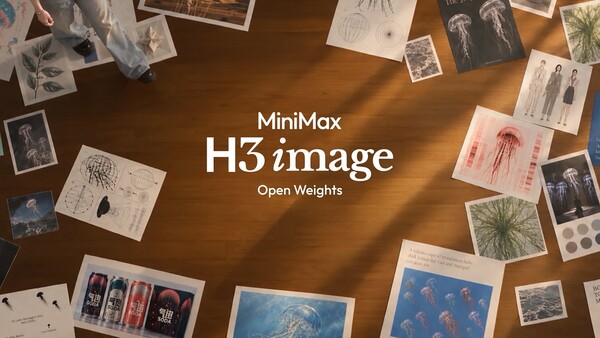
[DigitalToday reporter Jae-won Choi (최재원)] Chinese AI company MiniMax unveiled an AI model called MiniMax-H3-Image that generates roughly 16-megapixel images directly without a separate upscaling process. It is designed to speed up high-resolution image generation and supports editing and multi-image reference features.
On Nov. 11 (local time), Japanese media outlet Gigazine reported that MiniMax recently unveiled an image-generation model developed based on its video-generation AI, MiniMax H3. It also distributed the model weights so developers can run it in their own environments.
The biggest feature is its high-resolution image-generation capability. Existing image-generation AI has typically created low-resolution images and then improved quality through upscaling. H3 Image, by contrast, directly generates images of 4,096 pixels by 4,096 pixels, or about 16.78 megapixels.
MiniMax claimed it can create such high-resolution images within 10 seconds. Generation speed can vary depending on hardware and the execution environment, and there is no confirmation of independently verified results for the performance the company presented.
The model handles both image generation and editing. Users can create images through text commands or change the texture and composition of existing images. The company also released examples including photo-realistic images, 3D game concept images and images that include text.
Users can also input up to 16 reference images. MiniMax showcased cases such as combining photos of rooms and furniture to create interior images and visualising nearby terrain and buildings based on locations shown on a map.
The image-generation program ComfyUI also officially supports the model. Workflows for image generation and editing were released, and users can raise the default 4-megapixel setting to about 16 megapixels.
The model weights can be downloaded from Hugging Face. The terms of use, however, include regional restrictions. MiniMax's community licence excludes South Korea, the United States, the United Kingdom and the European Union from its coverage. Separate permission is required to use the model in those regions.
As models integrating high-resolution generation and editing features emerge, the scope of uses for image AI is expanding, but it is necessary to check actual performance and terms of use together.
 Jae-won Choi (최재원)
ittt_0801@d-today.co.kr