
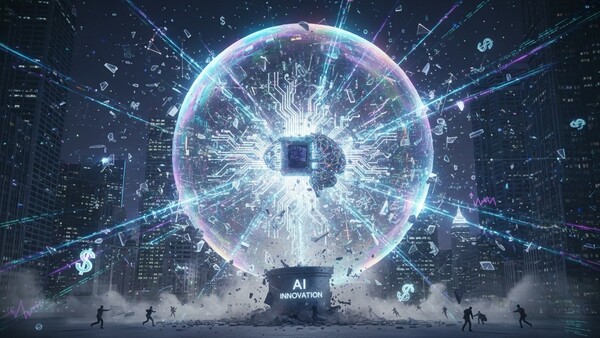
Amid growing concerns about a bubble bursting in the AI industry, a counterargument has been raised that explosive growth at major AI companies is based on real demand and still has ample room to expand.
On Nov. 11 local time, Japanese media outlet Gigazine reported that software engineer Matteo Raso (마테오 라소) argued in a recent blog post that massive investment and valuations in the AI industry do not necessarily mean there is a bubble.
Raso focused on the fact that large spending by AI companies is concentrated on securing computing infrastructure such as data centres. He said once initial buildouts are completed, the burden of spending could ease and profitability could improve as AI service revenue increases.
As evidence, he pointed to Anthropic's IPO filing. Anthropic posted about $2.08 in revenue, about 2,800 won, for every $1 of computing and infrastructure costs in the second quarter this year. This is a revenue-to-cost ratio and does not mean net profit.
Revenue is also rising sharply. Anthropic's revenue increased from $41 million in 2023 to $386 million in 2024 and $4.585 billion in 2025. It recorded $16.286 billion in the first half of this year.
Raso forecast that demand could increase further as AI spreads into areas such as coding and office automation. He also rebutted claims that narrowing technology gaps in open-source models will undermine the profitability of paid AI companies.
Raso also cited the fast-food industry, saying profits can be generated even if it is hard to differentiate from competitors. He analysed that the burden on ordinary users of building their own AI models and the cost for corporate customers to switch services could work in favour of existing providers.
But counterarguments are also strong. Data centres require continued investment in server replacement, power supply and maintenance even after construction.
Anthropic also posted an operating loss of $693 million in the first half of this year. While revenue is rising quickly, it is hard to conclude that profitability across AI companies has been secured.
At the end, Raso acknowledged risk factors such as excessive debt, regulation and local opposition to data centre construction. He added that while he does not rule out the possibility that there is a bubble in the AI industry, he does not agree with views that see a bubble burst as inevitable.
 Jae-won Choi
ittt_0801@d-today.co.kr