
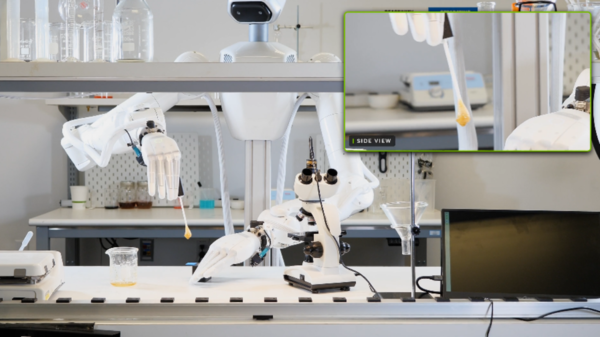
Nvidia has unveiled GR00T 2, an artificial intelligence model that learns from videos of human actions to help robots perform precise tasks.
According to blockchain media outlet The Defiant and Nvidia materials released on Monday local time, a 100,000-hour human demonstration dataset and related tools are now available. The model weights and training and tuning methods for applying it to specific robots are due to be released in December.
GR00T 2 is a world action model, or WAM, that predicts a robot's actions along with resulting changes in the surrounding environment. It generates the next move based on recently captured video, task instructions and the robot's condition. It can be applied to robots of different forms, including robot arms, five-finger robot hands and humanoids.
The core is its ability to transfer skills shown by humans to robots. It is designed to carry out tasks using human video or data from other robots even without demonstrations performed directly with a specific robot. The released dataset consists of video filmed from the operator's point of view and provides 100,000 hours from the human videos used in overall training.
In Nvidia's published evaluation, the target robot performed 40 of 50 tasks at least once without task-by-task demonstrations for that robot. The average success rate was 40 percent. It rose to 71 percent when the system was trained with one additional demonstration per task and to 95 percent when given five per task.
A lightweight model for humanoids, GR00T 2 Turbo, runs on Jetson Thor. Under the structure, a higher-level reasoning model decides the task, GR00T 2 Turbo plans the motions and a separate control system converts them into joint movements. Not all of the higher-level reasoning model runs inside the robot.
Nvidia also presented functions for carrying out multi-step tasks and responding to errors. An AI agent manages the work sequence and progress, while GR00T 2 handles precise motions such as grasping objects or fitting parts together. If a part is dropped or progress stops during work, the agent can carry out a recovery procedure and then continue the task.
It is also pushing for use in industrial sites. Foxconn is applying GR00T 2 to automate a server manufacturing plant, and Siemens is evaluating its potential for industrial use. Taiwan robot company Nexuni is testing the model for laundry-handling tasks.
Nvidia plans to support developers' use by providing data and tools first, then sequentially releasing model weights and application methods. A key element of this release is seen as reducing the burden of converting human demonstrations into robot skills and the additional training required for each robot.
 Yoonseo Lee
yslee@d-today.co.kr