
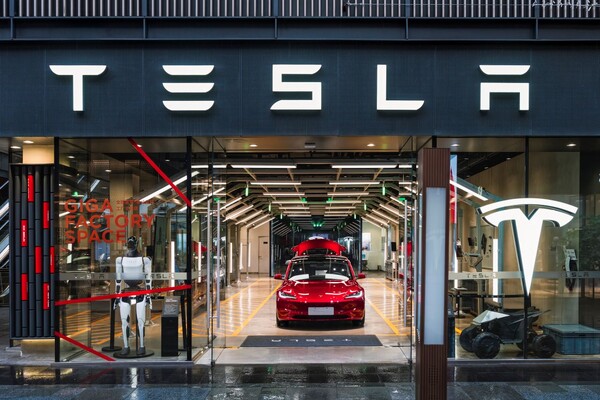
Tesla's domestic sales in China in October fell 66 percent from a year earlier to 8,817 vehicles.
Electrek, an electric-vehicle outlet, reported on Nov. 10 that this was the lowest monthly performance since July 2022.
Data compiled by the China Passenger Car Association (CPCA) showed wholesale sales by Tesla's China unit in October rose 10.3 percent from a year earlier to 67,829 vehicles. Of those, 59,012 were exports. Domestic sales in China, excluding exports, were 8,817 vehicles, accounting for 13 percent of total wholesale sales. The Shanghai plant operated normally, but 87 percent of vehicles produced were sent overseas.
By model, Model Y sales were 7,807 and Model 3 sales were 1,010. That was down 86.4 percent in a month from domestic sales of 64,837 vehicles in September. Tesla tends to prioritise exports early in a quarter and increase domestic deliveries toward the end of the quarter. Last year, after weak sales in October, it recovered to 73,145 vehicles in November and 93,843 in December.
Even so, some point out that this October's decline is hard to explain solely by the early-quarter focus on exports. Domestic sales in the first month of each quarter this year were 18,485 in January, 25,956 in April and 27,249 in July. October sales were less than half of those figures. Comparing October results alone, sales fell from 40,485 in 2024 and 26,006 in 2025 to 8,817 this year.
Tesla's decline also stood out as being larger than the overall weakness in China's EV market. CPCA final figures showed October retail sales of new energy vehicles (NEVs) in China fell 13.7 percent from a year earlier to 1,109,000 vehicles. The overall passenger car market fell 25 percent. Tesla's domestic sales fell 66.1 percent, and its share of China's NEV retail market was about 0.8 percent.
Competitors' results were in contrast. Xiaomi delivered more than 50,000 vehicles in October. Leapmotor recorded global deliveries of 106,127 vehicles, up 51 percent from a year earlier. BYD's October sales, including exports, were 490,168 vehicles.
Tesla's weak domestic sales in China were also clear in year-to-date results. Sales from January to October were 389,905 vehicles, down 15 percent from a year earlier. Over the same period, exports from the Shanghai plant were 420,984 vehicles, up 101 percent. Exports have surpassed domestic sales so far this year. Last year, domestic sales were more than double exports.
China's tax policy changes could also affect the expansion of exports. The Chinese government decided to cut the value-added tax refund rate for NEV exports from 13 percent to 9 percent from April 1, 2027. The refund rate applies based on the export date stated on the customs declaration.
The key will be whether domestic sales recover in November to December. If year-end sales rebound as they did last year, October's weakness could have been largely driven by quarterly shipment timing. If the recovery is limited, concerns could grow that slowing demand for the Model 3 and Model Y in the China market is becoming a structural problem.
 Seung-a Yoo
ysah@d-today.co.kr