
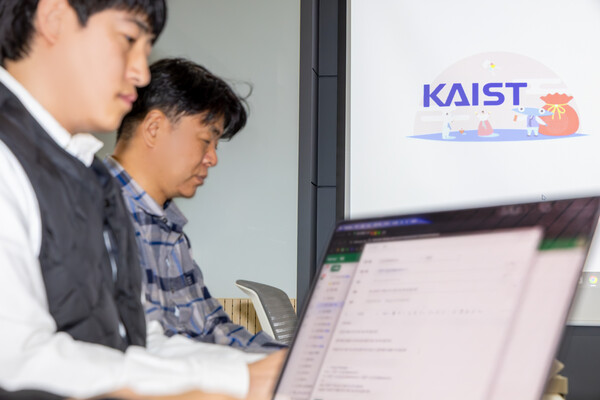
KT said on Tuesday it will provide its AI Email Security service to the Korea Advanced Institute of Science and Technology (KAIST) to strengthen the university-wide email security system.
KT AI Email Security is a cloud security service that detects and blocks cyber threats delivered by email, including ransomware and phishing emails, using AI technology. It applies a three-stage filtering system covering spam blocking, AI-based threat detection and APT in-depth analysis. The service detects phishing URLs and malicious files disguised as legitimate emails. KT obtained the Cloud Security Assurance Program (CSAP) certification for the solution’s cloud service in June.
The service was adopted after KAIST verified the technology. It also passed a security review by the National Intelligence Service, laying the groundwork to apply a cloud-based AI email security service across the university. KT will provide AI-based threat detection and an advanced persistent threat (APT) response system for all KAIST members, not limited to some researchers or specific organizations.
Unlike existing on-premises APT security solutions, it integrates spam, AI and APT security functions through a cloud-based software-as-a-service (SaaS) model. It removes the need to build a separate large-scale security infrastructure, reducing operational burdens. The service can be provided based on usage scale, allowing use by various organizations such as universities and research institutes.
KT will use the KAIST deployment to expand its AI email security business to major research and education institutions, including domestic universities and government-funded research institutes. It will support institutions that feel burdened by specialist security staffing or infrastructure operations so they can use AI-based threat detection and APT analysis functions.
Young-jin Kwon (권영진), head of KAIST’s Academic Information Office, said it is important to ensure that students, researchers, and faculty and staff can focus on research and education in a safe environment. He said the university will continue to advance its information security system so all members can receive a high level of security protection.
Seung-taek Baek (백승택), executive director and head of KT’s Enterprise Division West Regional Corporate Customer Headquarters, said KT will protect KAIST members and its research and educational assets through KT’s AI security technology. He said KT will expand AI security services to universities and research institutions based on this case.
 Jin-ho Lee (이진호)
jhlee26@d-today.co.kr