
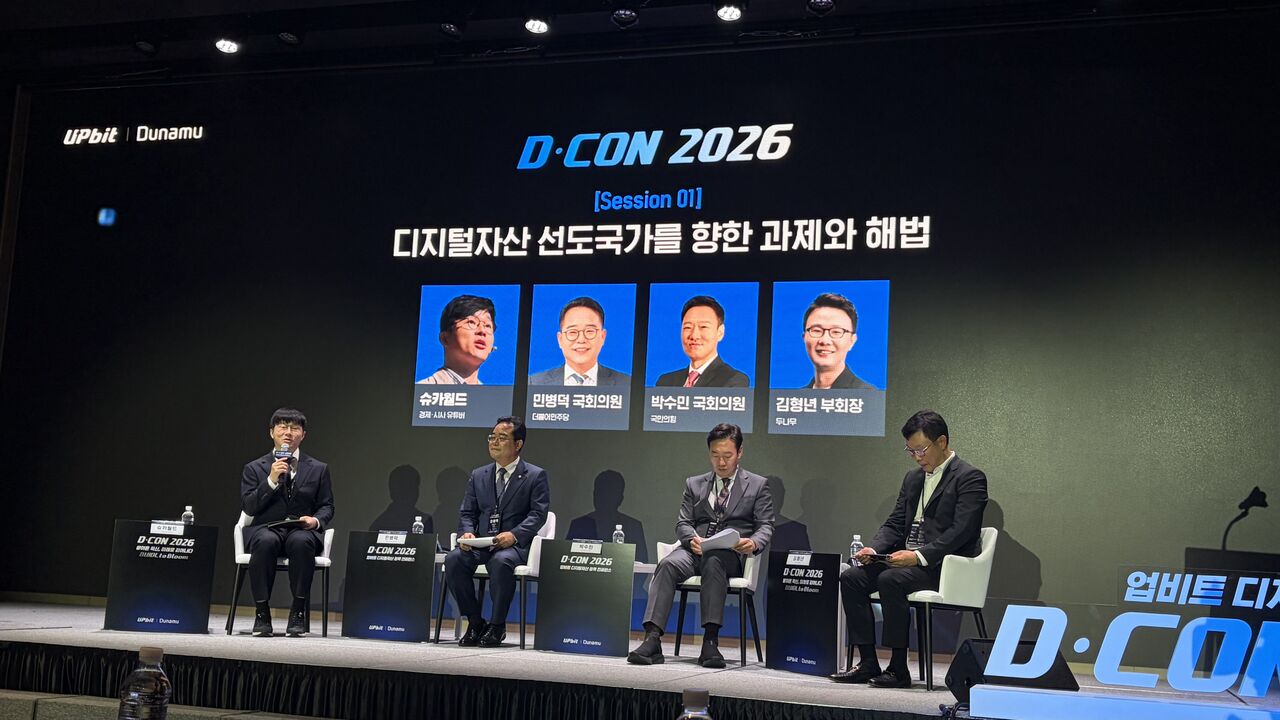
Hyung-nyeon Kim (김형년), vice chairman of Dunamu, stressed that Korea must remove institutional uncertainty in its domestic digital asset industry to compete in the global market. He cited tokenised assets, a won stablecoin and allowing foreign non-residents to use domestic exchanges as key tasks to expand the market.
In a special dialogue at 'D·CON 2026, Upbit Digital Asset Policy Conference' held on Monday at the Fairmont Hotel in Yeouido, Seoul, Kim spoke about competition and cooperation between traditional financial companies and digital asset firms. "I think Korea is also well prepared in terms of technology and talent," he said. "But there is a lot of concern because of uncertainty about whether we can do this in Korea," he added.
He said the boundary between traditional financial companies and digital asset firms has been breaking down quickly.
In the United States, the stock settlement cycle is being shortened, trading hours are being extended and tokenisation is under way to trade existing shares on blockchains. Kim said such changes show a move to use the efficiency of blockchains in traditional financial markets as well.
Dunamu also said it is expanding cooperation with existing financial companies.
Kim said that since financial companies acquired stakes in Dunamu, it has been researching businesses it can pursue together with the traditional financial sector in response to changes in the digital asset market. He said it is also filing applications for regulatory sandboxes for a number of projects.
"It is not institutionalised yet, but we are continuously studying how to make good use of the technologies we have now to protect Korea's finance, and not stop at simply protecting it, but go overseas and find new opportunities," he said.
Dunamu Chief Executive Kyung-seok Oh (오경석) also stressed in an opening speech that the scope of blockchain use is expanding beyond finance into the real economy.
"There is also a growing move to connect blockchain to the real economy," Oh said. "Now is the time for us to find specific answers about what competitiveness we will have and what path we will create," he added.
In the field of asset tokenisation, he pointed to the speed gap between domestic regulation and overseas markets.
Kim mentioned that shares of Korean companies such as Samsung Electronics and SK Hynix are being tokenised and traded on overseas platforms. He said that in Korea it is difficult to apply related technologies to actual business due to capital market regulations, even if the technology is in place.
"Technically, we are well prepared to apply it, but we cannot," he said. "Regardless of the system, we have made technical preparations with securities companies and financial companies for a long time as an operator," he added.
He added that "the technical parts are all finished" and stressed that "if you institutionalise it well, we can work hard going forward".
He also stressed the need to introduce a won stablecoin. He warned that dollarisation could deepen if dollar stablecoins spread faster in Korea and demand for using the won declines.
Kim said that if a structure is created in which dollar stablecoin holders receive economic benefits similar to interest, users may continue to hold dollars without converting them into won.
"U.S. stablecoin issuers are still knocking on the doors of Korean exchanges," he said. "If dollar stablecoins come in and people can receive interest or something similar to interest in personal wallets, the dollarisation effect could grow," he added.
He also proposed opening the domestic digital asset market to overseas investors.
"I hope we can make it so that foreign non-residents living in the United States, Europe or Southeast Asia can also use Korean exchanges," Kim said. He said there are currently significant restrictions for overseas users to sign up for domestic exchanges or trade on won markets.
He said that if a market is created where digital assets can be freely traded based on the won, like foreign investors exchange dollars into won to trade Korean stocks, "an environment to jump up one level" would open up.
On designing a won stablecoin system, he said it could refer to the deposit management system of existing digital asset exchanges.
Kim said user deposits at exchanges are also managed separately under relevant laws and rules require profits to be paid to users. "A stablecoin itself is not that different from our deposits," he said.
He added, "If you study the realistic parts and attach just a little of the technical parts, you can change it into a stablecoin as much as you want," and stressed the need to review related systems more strategically.
Dunamu executives also stressed the need to respond to security issues surrounding the financial sector and the digital asset industry.
Oh said new security threats using artificial intelligence are emerging. "Our industry is continuing the challenge to protect trust in the market by further strengthening security systems," he said.
Kim also spoke about Dunamu's future direction. "There are many opportunities, and there are also many things to think about, such as recent security threats," he said. "I will do my best so that we can represent Korea and become a player that expands globally," he added.
 Sangyeop Oh
yub@d-today.co.kr