
Tokenised stocks are growing rapidly this year. As regulatory preparations move forward, mainly in the United States, trading overseas in tokenised products based on South Korean shares is also increasing. That has prompted calls that South Korea's rules also need to reflect the trend.
The value of tokenised stocks in circulation on-chain stood at $3.58 billion as of Oct. 23, up 5.3 times from the start of the year, according to DigitalX Research Center on Oct. 29.
Compared with 54 percent growth in the overall real-world asset (RWA) market over the same period, it is the steepest rise among major asset groups.
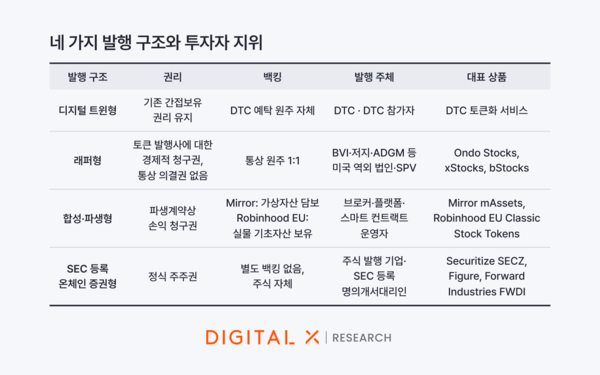
Tokenised stocks are divided by issuance structure into those that embed rights to actual shares in a token and those that only track share price moves.
So-called digital twin models and SEC-registered on-chain securities embed rights to actual shares in tokens, keeping dividends and voting rights. Wrapper models and synthetic and derivative models provide returns linked to share prices but do not grant voting rights.
Some 82 percent of outstanding tokenised stocks are products offered outside the United States by Binance, Ondo Finance, xStocks and Robinhood, most of which use wrapper structures.
Institutional changes are also continuing. In the United States, the central securities depository (DTC) processed actual transactions in July through a tokenisation pilot, and the U.S. Securities and Exchange Commission (SEC) granted an innovation exemption in September to an on-chain trading facility.
Still, an assessment says it is too early to view the market as having developed into a large-scale distribution market because the relevant systems are still at an early stage.
In South Korea, subordinate regulations are being prepared ahead of the enforcement of a revised Electronic Securities Act in February 2027. But current policy discussions focus on tokenised securities issued domestically, leaving tokenised stocks issued and traded overseas outside the system's scope.
In particular, as trading overseas has already expanded in tokenised products based on locally listed shares such as SK Hynix, some point out that South Korean regulation needs to consider overseas products as well.
Jung Ji-sung (정지성), a research fellow at DigitalX Research Center, said, "If the infrastructure to issue tokenised stocks is not put in place in South Korea, Korean tokenisation trading will establish itself first outside the scope of the formal system." He said, "Institutionalising the tokenised stock market depends on connecting rights, liquidity, collateral and reference prices under consistent rules."
 Oh Sang-yup
yub@d-today.co.kr