
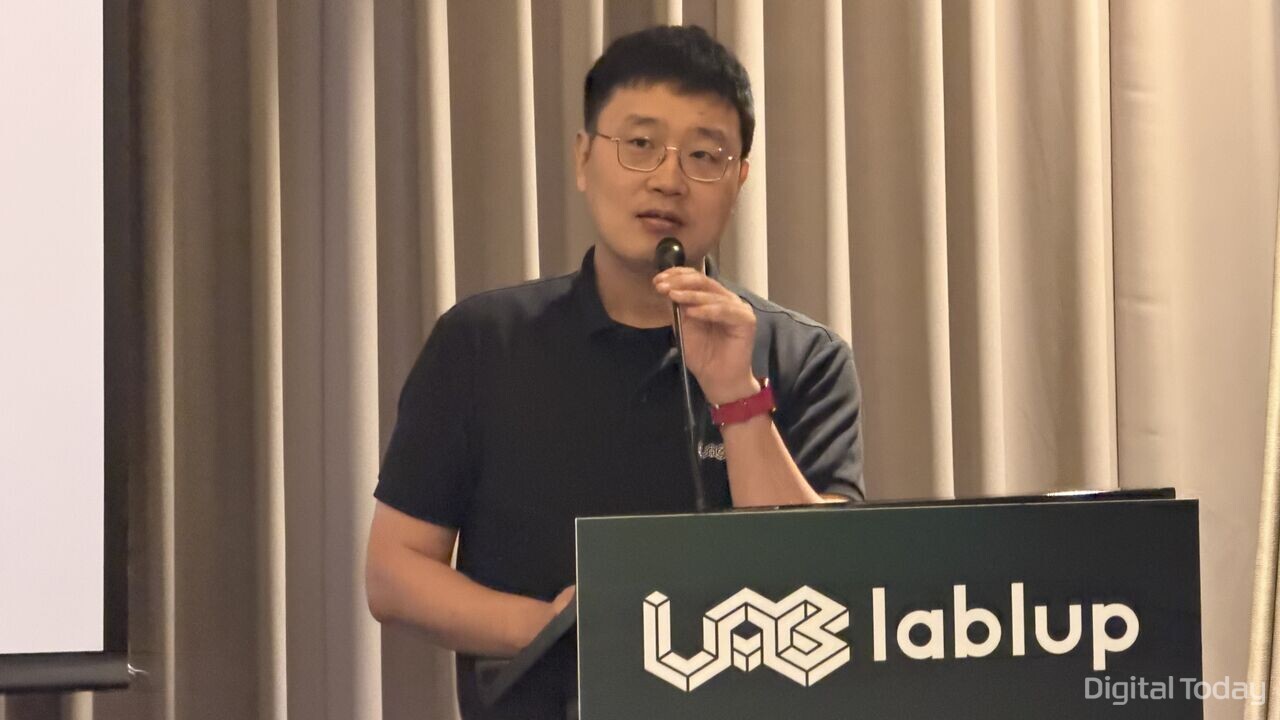
AI infrastructure software company Rableup plans to target global markets by leveraging integrated operations technology for heterogeneous AI accelerators and experience accumulated over more than 10 years. After listing on KOSDAQ, it plans to increase investment in technology to respond to next-generation AI semiconductors and overseas business. It also plans to expand its business scope from graphics processing unit (GPU) resource management to AI model inference and token usage and cost management.
Rableup CEO Jungkyu Shin (신정규) outlined the post-listing growth strategy at an IPO press briefing held at the Conrad hotel in Yeouido, Seoul, on Oct. 19.
Rableup, founded in 2015, specialises in AI infrastructure management and operations software. Its flagship product, Backend.AI, provides integrated support for AI infrastructure operations, from GPU partitioning virtualisation to AI workload orchestration and model training, inference and serving.
Rableup highlights as its competitive edge a full-stack integrated operations technology that is not dependent on a specific semiconductor maker. It supports more than 11 types of AI accelerators, including GPUs from Nvidia, AMD and Intel, as well as locally made neural processing units (NPUs). It can manage semiconductors from different manufacturers on a single platform and use them across various environments, including on-premise and cloud.
Shin said the company provides integrated services on a single platform from GPU virtualisation and orchestration to machine learning operations (MLOps) and AI model inference. He said it is an almost unique solution that offers everything on one platform, from semiconductor optimisation to the interface users interact with.
While Run:ai, a GPU resource management software company acquired by Nvidia, supports operating environments centred on Nvidia data centre GPUs, Rableup stresses compatibility that also covers semiconductors from rival makers such as AMD and Intel, as well as accelerators for edge use.
Open-source technology and large-scale operations experience are also strengths, it says. Rableup released Backend.AI as open source in 2017 and has supplied commercial products since 2019. A key feature is that instead of rebuilding systems for each customer, it reflects issues and solutions encountered across diverse environments into a single software product.
Shin said a time advantage secured by entering the market first is a technological moat. He said continued research and development is needed to maintain the gap with latecomers.
It currently supplies its product to more than 120 AI infrastructure operations sites, including research labs and data centres at companies and institutions in and outside South Korea. It has operated more than 2,000 GPUs at a single site. In customer deployments, it raised GPU utilisation to 85 percent from 30 percent and cut GPU budgets by 40 percent. It also secured training references covering more than 2,500 GPUs, including by participating in a government-led sovereign AI foundation model project.
Shin said the nature of the GPU operations software business can relatively reduce risks stemming from overinvestment in AI infrastructure. He said Rableup is positioned to hedge risks from volatility in hardware investment and, since it is not a provider that directly owns and rents out GPUs, it faces less burden from large-scale capital investment.
Revenue comes from annual subscription licences. Fees are set based on the number of physical GPU slots used by customers and the generation and performance tier of the semiconductors. Licence revenue increases when customers add GPUs or replace them with higher-performance products. Recurring revenue accounted for 94.7 percent of total revenue last year, and the average net revenue retention rate over the past 2 years was 131.9 percent.
Rableup posted 6.72 billion won in revenue and 679 million won in operating profit on a consolidated basis last year, recording operating profits for a second straight year.
Even so, Shin said competition in the AI industry is shifting from technological capability to the scale of capital as he explained the rationale for pursuing an IPO. He said a point comes when the industry moves from the scale of technology to the scale of capital. He added that reinvesting only profits generated from existing business makes it difficult to keep up with the pace of market growth.
Rableup plans to invest a significant portion of the offering proceeds in securing hardware to verify compatibility with next-generation AI semiconductors and use it for R&D to resolve in advance issues that could arise at customers.
Overseas, it aims to target demand for building sovereign AI infrastructure in each country and the neocloud market. Rableup has set 163 overseas neocloud operators as its target customer group and said it is currently in business talks with a double-digit number of companies. It plans to expand sales and technical support through local reseller networks in the United States, Britain and Singapore, and aims to achieve 57.9 billion won in revenue in 2029.
It is also expanding its business area from GPU resource management to AI service operations. It introduced Continuum Suite, which distributes requests across multiple AI models and manages token usage and costs, and AI:GO, which allows AI models to run directly on a personal computer. It plans to expand into the full process of AI service operations through Token Factory Suite.
Rableup’s indicated IPO price range is 19,000 to 22,000 won per share, with the total offering expected to be 41.4 billion to 48.0 billion won. Its expected market capitalisation after listing is 276.3 billion to 320.0 billion won. It plans to take retail subscriptions on Oct. 22 to 23 and list on the KOSDAQ market on Nov. 3.
 Seulgi Son
sageson@d-today.co.kr